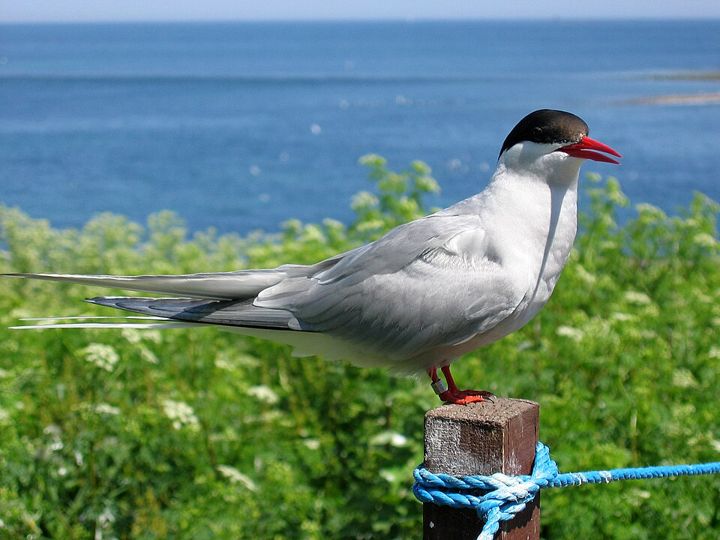
PAL, NA (widespread Arctic and subarctic coasts and inland, from Greenland, Iceland and British Isles to ne Siberia, Sakhalin and Kamchatka (e Russia), Aleutian Is., Alaska mainland through Arctic and subarctic Canada to James Bay, se Canada and New York)
IOC non-breeding range
subantarctic and oceans and Antarctic Ocean to edge of pack-ice
Identification
A medium-sized tern, 33–39 cm long with a 76–85 cm wingspan. Mainly grey and white with red bill and feet, white forehead, black crown and nape and white cheeks; long wings, a deeply forked tail with streamers and very short legs. It sees two summers a year, migrating from its Arctic breeding grounds to Antarctic waters and back, around 24,000 miles (at least 19,000 km each way), the longest migration known and more daylight than any other creature.
Habitat
Breeds on Arctic and subarctic coasts, islands and inland lakes, in colonies on sand and shingle, defending the nest fiercely; at sea the rest of the year, south to the edge of the Antarctic pack ice.
Distribution
Circumpolar breeder, in Europe south to Brittany, in North America to Massachusetts, in Asia to north-east Siberia, Sakhalin and Kamchatka; no subspecies. In East Asia only an occasional passage bird off Japan and the Chinese coast, rarely coming ashore; unrecorded in Singapore.
Season and behaviour
Occasional at sea off Japan's Pacific side in May and August–September; very rare off eastern China. It hardly ever stops on East Asian coasts, passing far offshore.
Photography tips
These are the FilmAnalysis editors' notes, not content from the sources.
Almost only from a boat, at 1/2500 s with continuous focus, the deep fork and short legs the marks. On Arctic breeding grounds it is the reverse: it dives at anyone near the nest, so wear a hat, keep your distance and use a long lens. Half a stop under for white plumage against bright sky.
Field ethics: keep a distance at which the bird does not change its behaviour; never approach or publish nest sites; no baiting, playback or flash; never clear vegetation around a nest; follow reserve rules and stay on paths.
Photographic styles
A white tern between sea and sky; the line of the tail streamers.
Similar species
Common tern (red bill with black tip or all black, longer legs, a dark wedge on the wingtip, common in East Asia); little tern far smaller.
Related badge
The album badge "a gull" unlocks when the vision model explicitly names a a gull in your photo and you rate the analysis. The badge stops at "a gull": it does not tell species apart, and this page existing unlocks nothing.
The illustration is original FilmAnalysis artwork. The photograph is from Wikimedia Commons; its licence and author are under it.