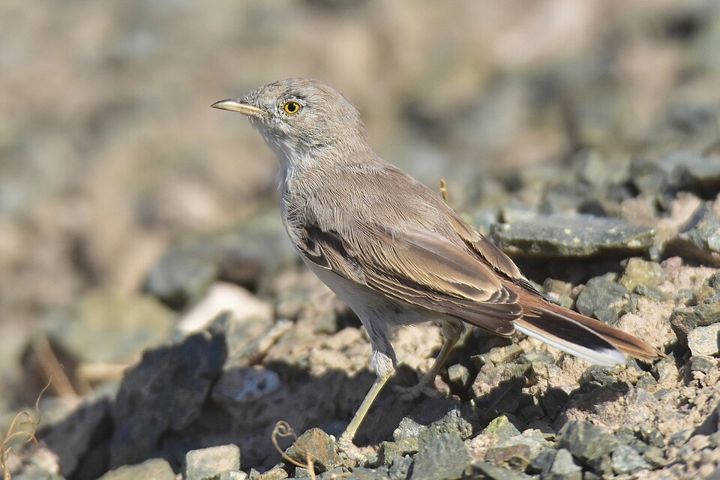
A very small warbler of about 11 cm. Pale sandy brown above with a rufous tail edged white and a reddish rump; whitish below; yellow eye, yellow bill base and legs. Rather confiding, it keeps to the base of low bushes and the ground and often feeds alongside desert wheatears. Until recently considered conspecific with the African desert warbler.
Habitat
Low scrub of desert and semi-desert, saxaul and tamarisk, dry river beds, hopping on the ground under bushes for insects; winters in similar arid habitats.
Distribution
Breeds in the deserts of Central and western Asia and the extreme east of Europe, from the Volga Delta east to western Inner Mongolia in China; in Xinjiang, Gansu and western Inner Mongolia from April to September; winters from Arabia to north-west India and the Red Sea coasts of north-east Africa. Absent from Japan and Singapore.
Season and behaviour
Breeds in Xinjiang and western Inner Mongolia from April to September, the male singing briefly from a bush top and otherwise low in the scrub.
Photography tips
These are the FilmAnalysis editors' notes, not content from the sources.
It works the base of bushes: crouch and wait for it to hop to the open edge, 1/1000 s; the yellow eye and rufous tail read only in front light. Desert noon is too harsh, so shoot early and late with the sand as one pale background. Never beat the bushes to drive it out.
Field ethics: keep a distance at which the bird does not change its behaviour; never approach or publish nest sites; no baiting, playback or flash; never clear vegetation around a nest; follow reserve rules and stay on paths.
Photographic styles
A small warbler under desert scrub; sand and rufous.
Similar species
Lesser whitethroat (larger, brown tail); African desert warbler (North Africa, no overlap); other sandy warblers lack the red tail.
Related badge
None yet. No validated photo recognition exists for this species, so no badge is tied to it: a name in the encyclopedia is not evidence in a photograph.
The illustration is original FilmAnalysis artwork. The photograph is from Wikimedia Commons; its licence and author are under it.