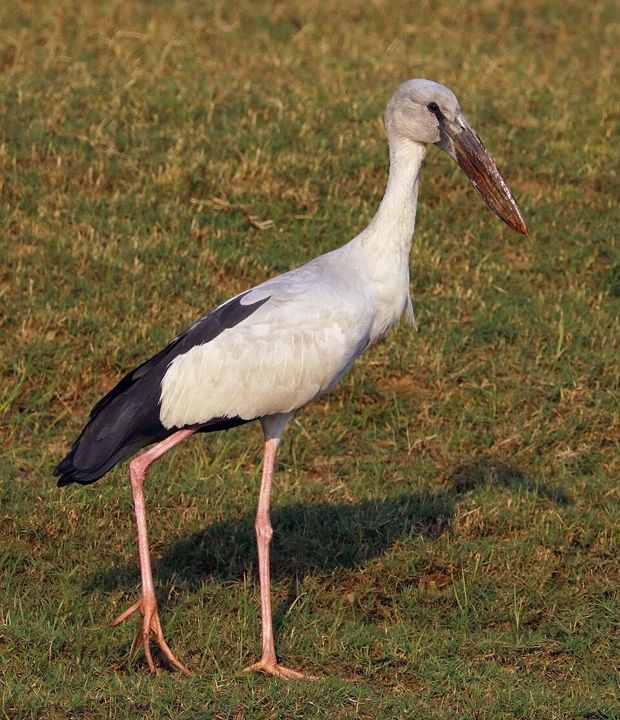
A large wader. Greyish outside the breeding season, white when breeding, with glossy black wings and tail with a green or purple sheen; adults have a distinct gap between the arched upper mandible and recurved lower one, thought to help in handling snails, which young birds lack. The bill is horn-grey, the legs pinkish to grey, turning red before breeding. At a distance it can look like a white or Oriental stork.
Habitat
Wetlands, paddies, marshes and shallow lakes, feeding mainly on snails including apple snails, in flocks in the rice fields; nests colonially in trees.
Distribution
Mainly the Indian subcontinent and South-East Asia; first recorded in China in October 2006 at Xihu, Eryuan, Yunnan, and since then regular and breeding in Yunnan and Guangxi; large flocks have visited Singapore in recent winters. Absent from Japan.
Season and behaviour
In Singapore in flock years from November to March; in south-west China all year, breeding. Walks slowly through paddies extracting snails from their shells.
Photography tips
These are the FilmAnalysis editors' notes, not content from the sources.
The gap in the bill needs a close side view with a long lens wide open. Use a car as a hide when flocks feed in the paddies; the evening flocks spiralling up on thermals to move on want a slightly wider lens. The white body is clean against the green of the rice, so do not let it clip.
Field ethics: keep a distance at which the bird does not change its behaviour; never approach or publish nest sites; no baiting, playback or flash; never clear vegetation around a nest; follow reserve rules and stay on paths.
Photographic styles
White flocks in paddy fields; birds circling at dusk.
Similar species
White and Oriental storks (straight bills without a gap, red legs, much larger); egrets (thin pointed bills).
Related badge
None yet. No validated photo recognition exists for this species, so no badge is tied to it: a name in the encyclopedia is not evidence in a photograph.
The illustration is original FilmAnalysis artwork. The photograph is from Wikimedia Commons; its licence and author are under it.