Elsewhere (in East Asia only in bird parks or botanic gardens)
Habitat
coast and mangroves
Colour
black, white, orange
Size
medium (20 to 50 cm)
IUCN status
Vulnerable
IOC breeding range
PAL, NA (subarctic and temperate North Atlantic coasts: w, ec Greenland, Iceland, Faroe, British, and Channel is., nw France, s to n Scandinavia, Svalbard (n of Norway) and Novaya Zemlya (nw Russia); n Hudson Bay to se Canada and Maine (e Canada, ne USA))
IOC non-breeding range
pelagic in North Atlantic and marginal seas, to North Carolina in Gulf Stream of w North Pacific and to Azores (n Macaronesia, nw of Africa) and Iberian Pen.
Identification
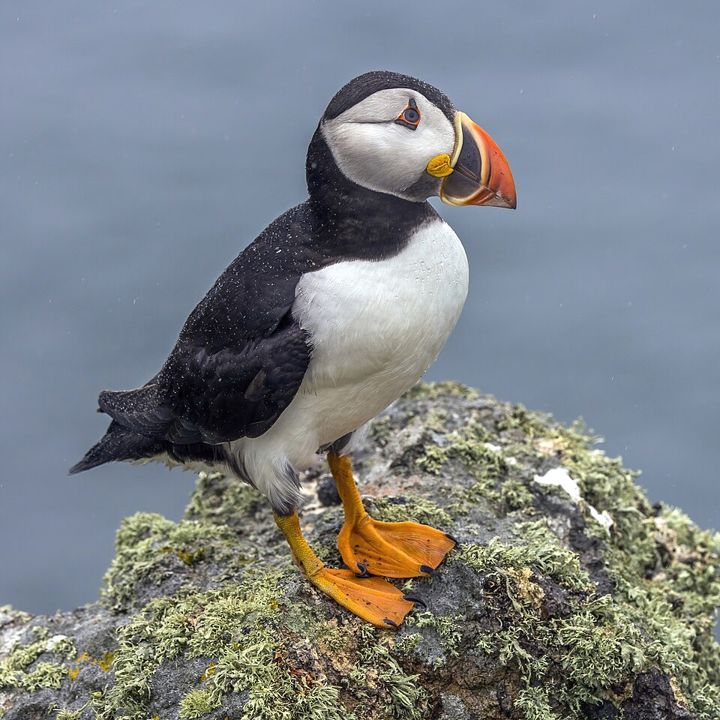
A sturdily built auk with a thick neck and short wings and tail, 28–30 cm long, wingspan 47–63 cm, standing about 20 cm tall. Glossy black forehead, crown, nape, back, wings and tail, a broad black collar round neck and throat; a large lozenge of very pale grey on each side of the head; in the breeding season the huge triangular bill is red, orange and blue-grey, with a small peaked horny blue-grey patch above the eye that makes it look almost triangular. In winter the bill shrinks and dulls.
Habitat
Grassy slopes on Atlantic islands and cliff tops, nesting in burrows and returning with rows of small fish for the chick; winters far out at sea.
Distribution
The only Atlantic puffin, breeding in Russia, Iceland, Ireland, Britain, Norway, Greenland, Newfoundland, Nova Scotia and the Faroes, south to Maine and Brittany, most numerous in Iceland's Westman Islands. The Pacific relatives are the tufted and horned puffins. Absent from East Asia; declining fast in places and listed as vulnerable.
Season and behaviour
At North Atlantic colonies from May to August, the Faroe and Icelandic cliff tops busiest in July; at sea in winter.
Photography tips
These are the FilmAnalysis editors' notes, not content from the sources.
Puffins on a colony cliff top tolerate people well: lie on the slope with a medium telephoto at eye level and wait for one to land with a bill full of fish, 1/2000 s. The coloured bill is truest in soft overcast light and the white face clips in direct sun. Footsteps collapse burrows, so keep to the paths.
Field ethics: keep a distance at which the bird does not change its behaviour; never approach or publish nest sites; no baiting, playback or flash; never clear vegetation around a nest; follow reserve rules and stay on paths.
Photographic styles
A bright-billed seabird on a grassy cliff top; black and white with orange-red.
Similar species
Horned and tufted puffins (North Pacific, plumes when breeding); rhinoceros auklet (grey, orange bill).
Related badge
None yet. No validated photo recognition exists for this species, so no badge is tied to it: a name in the encyclopedia is not evidence in a photograph.
The illustration is original FilmAnalysis artwork. The photograph is from Wikimedia Commons; its licence and author are under it.