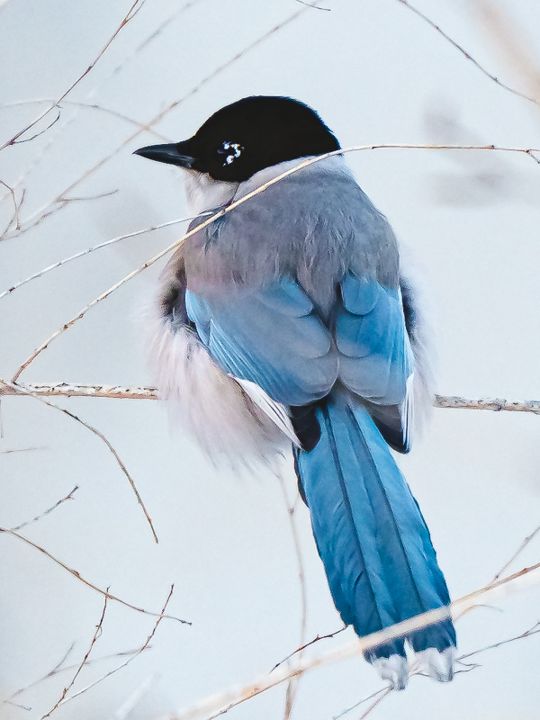
31–35 cm, like a slimmer, smaller magpie with proportionally smaller legs and bill. Glossy black cap from forehead to nape, white throat; underparts and back light grey-fawn, wings and the 16–20 cm tail azure blue. Flocks keep up a chorus of hoarse calls.
Habitat
Coniferous forest, mainly pine, and broadleaf woodland, including parks, gardens and street trees; very common in the cities of northern China, moving through the canopy in loose, follow-the-leader flocks.
Distribution
A large region of eastern Asia: China, Korea and Japan, north into Mongolia and southern Siberia. The Iberian population once thought conspecific is now the separate Iberian magpie. Absent from Singapore.
Season and behaviour
Resident, seen all year; flocks are larger in winter, streaming through the parks of Beijing and Xi'an. Breeds April to June, with the group defending the nests together.
Photography tips
These are the FilmAnalysis editors' notes, not content from the sources.
The line of birds flying one after another is its signature picture: a slightly wider lens and wait for the procession to enter the frame. The azure wings and tail hold their colour even on grey days but glow in front light; the black cap loses detail against the sun. In parks they come close, so a medium telephoto is enough.
Field ethics: keep a distance at which the bird does not change its behaviour; never approach or publish nest sites; no baiting, playback or flash; never clear vegetation around a nest; follow reserve rules and stay on paths.
Photographic styles
Grey-blue group pictures; winter in a northern park.
Similar species
Iberian magpie (white tail tip, Europe); Oriental magpie (black and white, much larger); red-billed blue magpie (longer tail, red bill, southern hills).
Related badge
The album badge "a magpie" unlocks when the vision model explicitly names a a magpie in your photo and you rate the analysis. The badge stops at "a magpie": it does not tell species apart, and this page existing unlocks nothing.
The illustration is original FilmAnalysis artwork. The photograph is from Wikimedia Commons; its licence and author are under it.