Singapore and tropical Asia, Japan and temperate East Asia
Habitat
rivers and wetlands
Colour
brown, grey, white
Size
small (under about 20 cm)
IUCN status
Least Concern
IOC breeding range
PAL, AF, OR, AU (widespread)
Identification
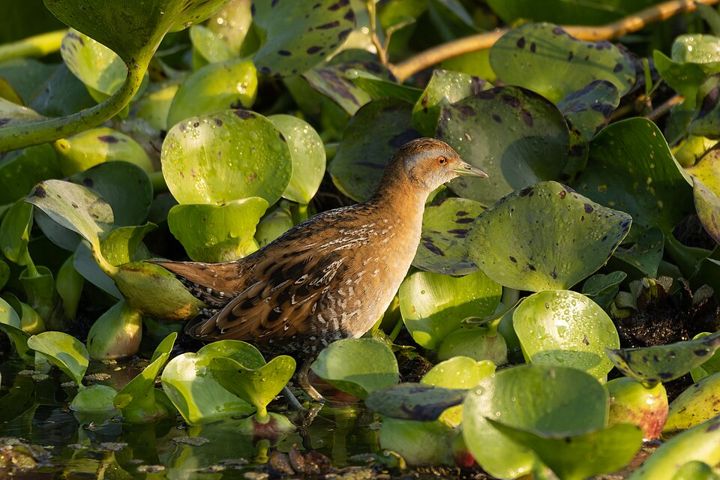
A very small crake, 15–18 cm. Brown above with black-and-white markings, blue-grey face, neck and breast, black-and-white bars on the flanks and undertail; a short green bill, green legs and a red eye. Juveniles are buff below with markings. Extremely secretive, stepping along the edge of sedge and reeds and darting back into cover when alarmed.
Habitat
Sedge marsh, reed ponds, paddies and wet meadows, nesting in dry spots within wet sedge bogs with four to eight eggs.
Distribution
Across Eurasia and Africa, New Guinea, Australia and New Zealand, breeding from eastern Europe to Honshu in Japan; migratory populations winter in East Africa and South Asia. Mostly a passage migrant in eastern China, a breeder on Honshu, and a winter visitor to Singapore's marshes.
Season and behaviour
In Singapore from October to March; on passage in eastern China in April–May and September–October; breeding in Japan from May to September. Active at the edge of cover at dawn and dusk; the call is a dry frog-like rattle.
Photography tips
These are the FilmAnalysis editors' notes, not content from the sources.
It comes out onto open mud at the edge of the vegetation for a few minutes at dawn and dusk: be at a fixed gap beforehand, stay still, use a long lens and high ISO. The barred flanks and red eye are the point. Never wade into the marsh to push it out, and no playback.
Field ethics: keep a distance at which the bird does not change its behaviour; never approach or publish nest sites; no baiting, playback or flash; never clear vegetation around a nest; follow reserve rules and stay on paths.
Photographic styles
A hidden small bird at the reed edge; low-light browns.
Similar species
Other small crakes: ruddy-breasted crake (chestnut breast, unbarred flanks); spotted crake (white spots on the breast, larger).
Related badge
None yet. No validated photo recognition exists for this species, so no badge is tied to it: a name in the encyclopedia is not evidence in a photograph.
The illustration is original FilmAnalysis artwork. The photograph is from Wikimedia Commons; its licence and author are under it.