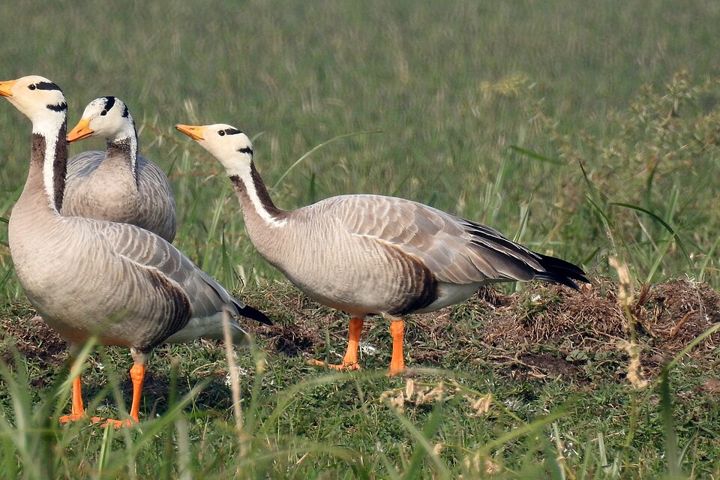
A mid-sized goose, 71–76 cm long and 1.87–3.2 kg. Pale grey overall, paler than any other grey goose; the white head carries two black bars and a white line runs down the neck side, the easiest marks of all; bill and legs orange-yellow. In flight the typical goose honking.
Habitat
Breeds at high-altitude lakes in Central Asia, grazing short grass on the shores in colonies of thousands; winters on lowland lakes, rivers and farmland.
Distribution
Breeds on the Tibetan plateau (Qinghai Lake is one of the largest colonies), in Kazakhstan, Mongolia and Russia; crosses the Himalayas on migration at recorded heights up to 8,800 m, among the highest of any bird; winters on the Indian subcontinent, in Myanmar and in Yunnan and southern Tibet, with large flocks in the Lhasa valley. Introduced non-migratory populations in Britain and southern Jutland. Extremely rare in Japan; absent from Singapore.
Season and behaviour
Breeds at Qinghai Lake, Namtso and other lakes from April to August; winters at Dashanbao in Yunnan and around Lhasa from October to March, where in the wetland parks they graze beside people.
Photography tips
These are the FilmAnalysis editors' notes, not content from the sources.
The two black head bars are the mark and the point of the picture, clearest in a front-lit profile; the tame wintering birds at Lhasa allow a medium lens with snow mountains and monasteries behind. Flight lines over snow peaks compress with a long lens at 1/1600 s. The breeding islands of Qinghai Lake are reserves: never land.
Field ethics: keep a distance at which the bird does not change its behaviour; never approach or publish nest sites; no baiting, playback or flash; never clear vegetation around a nest; follow reserve rules and stay on paths.
Photographic styles
Goose flocks by plateau lakes and snow mountains; light grey and white.
Similar species
Greylag (no head bars, pink bill); greater white-fronted goose (white forehead, black belly bars); the bar-headed is the only goose with barred head.
Related badge
The album badge "a duck" unlocks when the vision model explicitly names a a duck in your photo and you rate the analysis. The badge stops at "a duck": it does not tell species apart, and this page existing unlocks nothing.
The illustration is original FilmAnalysis artwork. The photograph is from Wikimedia Commons; its licence and author are under it.