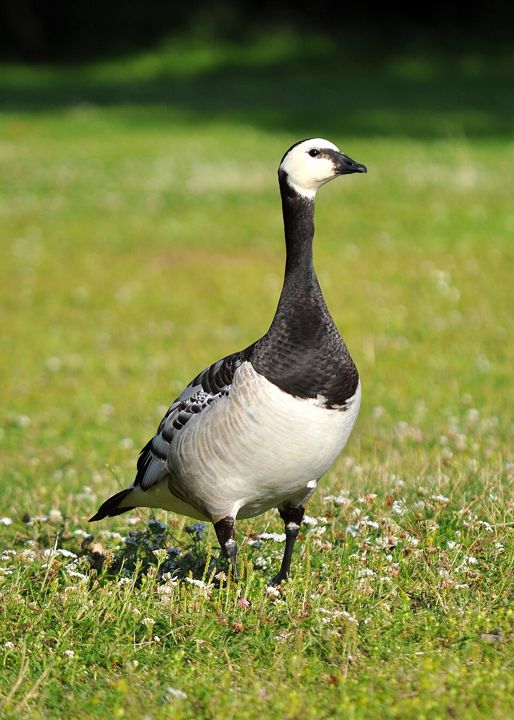
PAL (high Arctic e Greenland, Svalbard (n of Norway), Novaya Zemlya and nearby Kolguyev and Vaygach is. (nw Russia))
IOC non-breeding range
to coastal n British Isles, s Scandinavia, and nw Europe
Identification
A medium-sized goose of the black-goose genus, with extensive black in the plumage that separates it from the grey Anser geese. White (or cream) face, black crown, neck and breast, grey back barred black and white, white underparts, black legs and small black bill. The name comes from the medieval belief that it grew from goose barnacles. Genetic analysis shows its closest relative is the cackling goose, not the brant.
Habitat
Breeds on Arctic island cliffs and tundra, the chicks leaping from the cliffs soon after hatching; winters on coastal salt marsh, grassland and farmland, grazing in large flocks.
Distribution
Three original populations: breeding in eastern Greenland and wintering in the Hebrides and western Ireland; breeding on Svalbard and wintering on the Solway Firth; breeding on Novaya Zemlya and nearby islands and wintering in the Netherlands and Germany; new populations since the 1960s in Iceland and the Baltic. Only an extreme vagrant in East Asia, with scattered records from China and occasional birds in northern Japan; absent from Singapore.
Season and behaviour
East Asian records are mostly from November to March, among bean and white-fronted geese; the European wintering grounds hold tens of thousands from October to April.
Photography tips
These are the FilmAnalysis editors' notes, not content from the sources.
Find it in a goose flock by the white face and black neck, scanning with a long lens; black, white and grey are softest under cloud, and the back barring shows only in front light. A rising flock needs 1/2000 s and a slightly wider lens. In East Asia it is a vagrant, so never lift the whole flock for it.
Field ethics: keep a distance at which the bird does not change its behaviour; never approach or publish nest sites; no baiting, playback or flash; never clear vegetation around a nest; follow reserve rules and stay on paths.
Photographic styles
A black-and-white face in the goose flock; winter crowds on grass.
Similar species
Brant goose (all-black face and neck with only a small white neck patch, darker body); Canada goose (white cheek but black crown, long neck, brown body); cackling goose (smaller, closely related).
Related badge
The album badge "a duck" unlocks when the vision model explicitly names a a duck in your photo and you rate the analysis. The badge stops at "a duck": it does not tell species apart, and this page existing unlocks nothing.
The illustration is original FilmAnalysis artwork. The photograph is from Wikimedia Commons; its licence and author are under it.