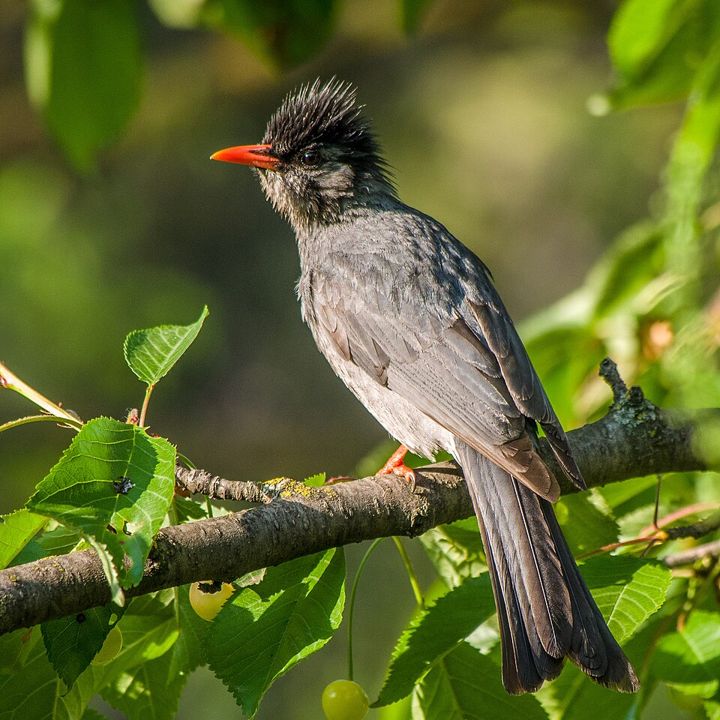
Photo: Mike Prince from Bangalore, India, via Wikimedia Commons, licensed CC BY 2.0. Unmodified apart from resizing.
Region
Japan and temperate East Asia
Habitat
forest
Colour
black, red, white
Size
medium (20 to 50 cm)
IUCN status
Least Concern
IOC breeding range
OR (widespread)
Identification
24–25 cm long with a long tail. Body plumage from slate grey to shimmering black depending on the race; bill, legs and feet all orange-red, with a fluffy black crest. The nominate race and some southern Chinese races have a wholly white head, especially striking in winter. Sexes alike; young birds lack the crest, have whitish underparts with a grey breast band and a brown tint above. A black streak behind the eye and on the ear coverts.
Habitat
Broadleaf forest, cultivation and gardens in hilly country, mainly evergreen and deciduous forest at middle elevations, moving up and down with the food supply, Himalayan birds descending to the plains in winter; noisy flocks in the canopy eating fruit, nectar and insects.
Distribution
From Pakistan along the Himalayas through India and Nepal to South-East Asia and southern China and Taiwan, in ten subspecies; common in south-west and southern China and Taiwan, the white-headed races in southern China and Hainan. Absent from Japan and Singapore.
Season and behaviour
Resident, seen all year; in winter flocks of the white-headed race are common in southern China, a good season to watch them; breeds from April to July.
Photography tips
These are the FilmAnalysis editors' notes, not content from the sources.
The orange-red bill and feet on a black body catch the eye at once, most in front light; the white-headed race contrasts strongly with dark green canopy, so take half a stop off to keep the white head. They stay in the upper canopy: a long lens from below, waiting for a stretched calling head or a raised crest.
Field ethics: keep a distance at which the bird does not change its behaviour; never approach or publish nest sites; no baiting, playback or flash; never clear vegetation around a nest; follow reserve rules and stay on paths.
Photographic styles
Black and red in the canopy; the strong contrast of the white-headed race.
Similar species
Chestnut bulbul (chestnut back); mountain bulbul (olive-green body, brown crest); no other black bulbul has a red bill.
Related badge
None yet. No validated photo recognition exists for this species, so no badge is tied to it: a name in the encyclopedia is not evidence in a photograph.
The illustration is original FilmAnalysis artwork. The photograph is from Wikimedia Commons; its licence and author are under it.