Singapore and tropical Asia, Japan and temperate East Asia
Habitat
rivers and wetlands, coast and mangroves
Colour
black, grey, white
Size
medium (20 to 50 cm)
IUCN status
Least Concern
IOC breeding range
Worldwide (except AU)
Identification
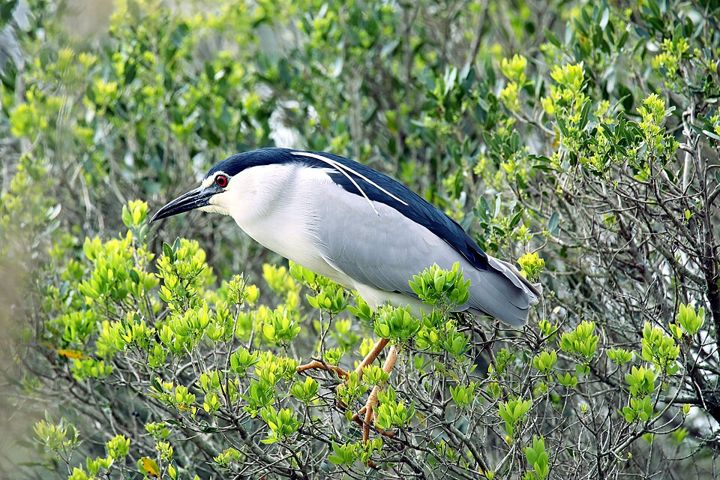
A medium-sized heron, stockier than the egrets and day herons, with a short bill, legs and neck. Adults have a black crown and back, pale grey wings, white or grey-white underparts, red eyes and short yellow legs, with one to a few long slender white plumes from the back of the head. It stands hunched with the neck drawn in and stretches it only to hunt. Juveniles are brown, heavily spotted white, with orange-yellow eyes.
Habitat
Fresh and salt wetlands, rivers, ponds, mangroves and the water's edge in city parks; roosts by day in dense trees and comes out to feed after dusk.
Distribution
Found over much of the world, in Africa, Asia, Europe and the Americas; replaced in Australasia by the closely related Nankeen night heron. Common in China, Japan and Singapore, where park ponds often hold daytime roosts.
Season and behaviour
Seen all year; northern birds move south in winter. Mainly active at dusk and at night; by day the roosting groups sit motionless in the canopy. For a short time in courtship the legs turn salmon-pink and the skin around the eye blue.
Photography tips
These are the FilmAnalysis editors' notes, not content from the sources.
Find the roost tree by day and shoot the hunched silhouettes from below; at dusk, as they fly out to feed, use high ISO and 1/500 s against the backlight. The spotted juveniles photograph better than the adults, so do not pass them by. Approach a roost slowly: when one leaves, they all do.
Field ethics: keep a distance at which the bird does not change its behaviour; never approach or publish nest sites; no baiting, playback or flash; never clear vegetation around a nest; follow reserve rules and stay on paths.
Photographic styles
Low-light dusk silhouettes; black, white and grey minimalism.
Similar species
Nankeen night heron (chestnut back, Australasia); juveniles resemble young bitterns but are larger and heavier.
Related badge
None yet. No validated photo recognition exists for this species, so no badge is tied to it: a name in the encyclopedia is not evidence in a photograph.
The illustration is original FilmAnalysis artwork. The photograph is from Wikimedia Commons; its licence and author are under it.