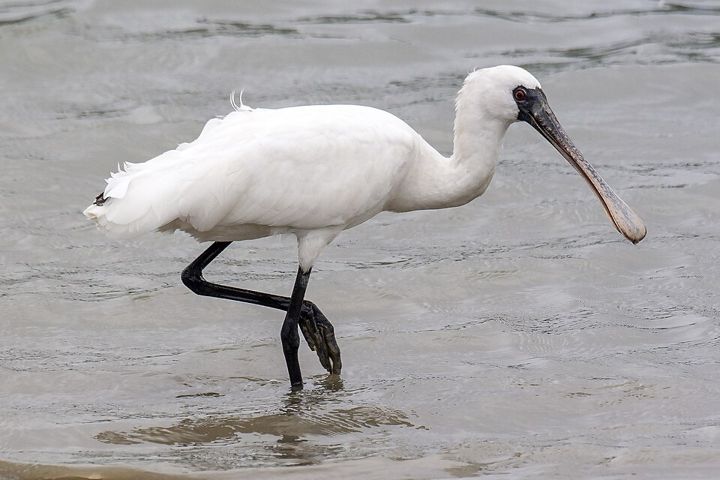
A large white wader with a long flat bill widening into a black spoon; the bare face is black too, which separates it from the Eurasian spoonbill's yellow bill tip and white face. In the breeding season yellow plumes grow from the nape and a yellow wash crosses the breast. Legs black. It feeds by sweeping the bill from side to side in shallow water, finding fish and shrimp by touch.
Habitat
Coastal intertidal mud, estuaries, fish ponds and salt pans, resting in groups in the shallows or on bunds by day and feeding at dawn and dusk; breeds colonially on cliffs of islands off north-east Asia.
Distribution
The most restricted of the six spoonbills, confined to the coasts of eastern Asia: breeds on the west coast of Korea and islands off north-east China, winters in Taiwan (Qigu, Tainan), Hong Kong's Mai Po, the south-east China coast, northern Vietnam and Kyushu and Okinawa in Japan. Only 288 were counted worldwide in 1988–90; sustained conservation brought 2,346 by 2010 and over six thousand in recent years.
Season and behaviour
On the south-east China coast, in Taiwan, Hong Kong and southern Japan from October to April; breeding in the north from May to July. Easiest to watch at high-tide roosts.
Photography tips
These are the FilmAnalysis editors' notes, not content from the sources.
Photograph the resting flock from behind the bund with a long lens and stay off the mud. At dusk, against the light, the sweeping bill throws spray at 1/2000 s; take half a stop off for white plumage on a bright background. In spring the yellow plumes make the head portrait. It is a protected, threatened bird: never do anything that lifts the flock.
Field ethics: keep a distance at which the bird does not change its behaviour; never approach or publish nest sites; no baiting, playback or flash; never clear vegetation around a nest; follow reserve rules and stay on paths.
Photographic styles
White flocks on the flats; backlit dusk silhouettes.
Similar species
Eurasian spoonbill (yellow bill tip, white face, slightly larger, often in the same flock).
Related badge
None yet. No validated photo recognition exists for this species, so no badge is tied to it: a name in the encyclopedia is not evidence in a photograph.
The illustration is original FilmAnalysis artwork. The photograph is from Wikimedia Commons; its licence and author are under it.