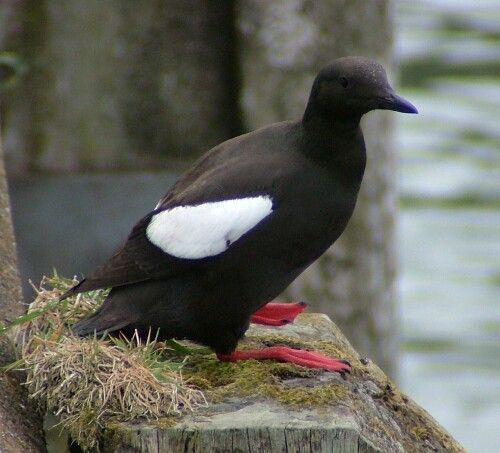
Photo: Kelson, via Wikimedia Commons, public domain / CC0. Unmodified apart from resizing.
Region
Japan and temperate East Asia
Habitat
coast and mangroves
Colour
black, white, red
Size
medium (20 to 50 cm)
IUCN status
Least Concern
IOC breeding range
NA, PAL (coasts of high Arctic to n temperate North Atlantic and Arctic Ocean)
IOC non-breeding range
to ice-free waters near breeding range
Identification
A medium-sized seabird, 30–32 cm long with a wingspan of 52–58 cm and weighing 300–460 g. In breeding plumage totally black except for a large white patch on the upper wing; legs, feet and the inside of the mouth bright coral red, bill black. After the autumn moult the upperparts are barred pale grey and white, the head pale grey, the underparts white and the feet pale red, the white wing patch retained. Sexes cannot be told apart in the field.
Habitat
Coastal and intertidal waters and inshore seas, staying closer to shore than other auks; nests in rock crevices, boulder scree and gaps in harbour walls; resident over most of its range, high-Arctic birds moving south in winter.
Distribution
Northern Europe, the North Atlantic and parts of the Arctic: the coasts of Canada, Greenland, Iceland, the British Isles, Scandinavia and Russia; the Pacific has the closely related pigeon guillemot. Only a very few records from Japan; absent from China and Singapore.
Season and behaviour
Hardly ever seen in East Asia; at North Atlantic colonies from May to August it sits on harbour breakwaters, the red feet the first thing you notice.
Photography tips
These are the FilmAnalysis editors' notes, not content from the sources.
In the breeding season it perches on breakwaters and rocks: the red feet and the red gape when it calls are the point, front-lit at 1/1000 s; black plumage blocks up, so a little under. The moment before a dive and the wing flap that shows the white patch want bursts.
Field ethics: keep a distance at which the bird does not change its behaviour; never approach or publish nest sites; no baiting, playback or flash; never clear vegetation around a nest; follow reserve rules and stay on paths.
Photographic styles
Black, white and red coastal studies; portraits on harbour rocks.
Similar species
Pigeon guillemot (North Pacific relative, black wedge in the wing patch); murres and razorbill (white below, no red feet).
Related badge
None yet. No validated photo recognition exists for this species, so no badge is tied to it: a name in the encyclopedia is not evidence in a photograph.
The illustration is original FilmAnalysis artwork. The photograph is from Wikimedia Commons; its licence and author are under it.