PAL (coastal far s Greenland, inland Iceland, temperate and subarctic w Europe across Russia to Yakutsk region, Kamchatka, Sakhalin (e Russia); in south through Caspian Sea, n Central Asia, n, c Mongolia and ne China; also wc Newfoundland (se Canada))
IOC non-breeding range
AF, IO, OR : to coasts and offshore waters of n Atlantic Canada, se Greenland, North Sea and w Atlantic to Mediterranean and marginal seas; to Canary Is. and wc Africa; Arabian Sea and associated gulfs, n Indian Ocean; w North Pacific coasts from Japan to se China and Philippines; also inland in parts of Africa, Indian Subcontinent and se Asia
Identification
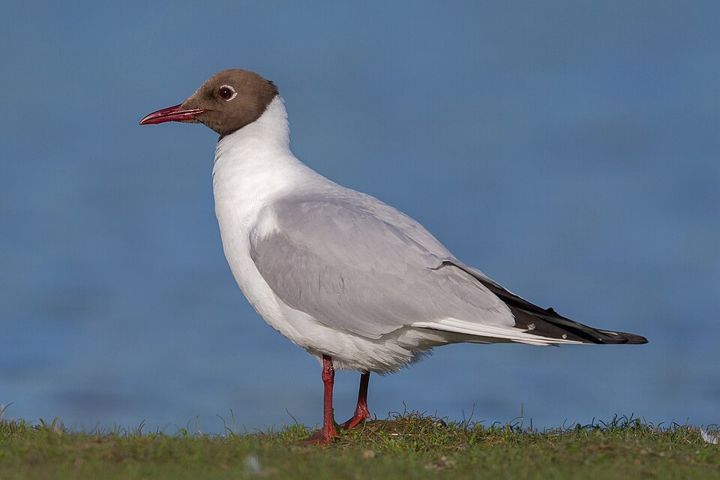
A small gull, 34–39 cm long with a 100–110 cm wingspan. In summer a chocolate-brown hood that looks black at a distance, white neck, underparts and tail, pale grey wings and back, black primary tips, red bill and legs. In winter the hood goes, leaving one or two dark spots behind the eye. A white leading edge to the outer wing in flight is a good field mark.
Habitat
Coasts, estuaries, harbours, lakes, reservoirs, rivers and city waters; breeds in colonies on inland marshes and lakes and gathers in winter wherever people feed birds.
Distribution
Breeds across most of the Palearctic, from Greenland, Iceland and Europe through Russia to Kamchatka and Sakhalin, with a few in coastal eastern Canada; winters on southern coasts and inland waters. The commonest winter gull in eastern China and Japan, famous for the flocks on Kunming's Dian Lake; rare in Singapore.
Season and behaviour
In eastern China and Japan from October to April; the hood starts to return from March. In winter hundreds or thousands gather in parks and along rivers, following boats and walkers.
Photography tips
These are the FilmAnalysis editors' notes, not content from the sources.
In city winters they are almost tame and the best practice for flight tracking: shoot translucent wings against the light, or white shapes against dark water. Half-moulted hoods in February and March give piebald faces. Do not feed them for pictures.
Field ethics: keep a distance at which the bird does not change its behaviour; never approach or publish nest sites; no baiting, playback or flash; never clear vegetation around a nest; follow reserve rules and stay on paths.
Photographic styles
Winter riverside crowds; white and blue-grey tones.
Similar species
Brown-headed gull (slightly larger, pale brown hood in summer, white spots in the black wingtips, western China and South Asia); Caspian gull far larger.
Related badge
The album badge "a gull" unlocks when the vision model explicitly names a a gull in your photo and you rate the analysis. The badge stops at "a gull": it does not tell species apart, and this page existing unlocks nothing.
The illustration is original FilmAnalysis artwork. The photograph is from Wikimedia Commons; its licence and author are under it.