Japan and temperate East Asia, Singapore and tropical Asia
Habitat
coast and mangroves, towns and gardens
Colour
brown, black
Size
large (over 50 cm)
IUCN status
Least Concern
IOC breeding range
PAL, AF, OR, AU (widespread)
Identification
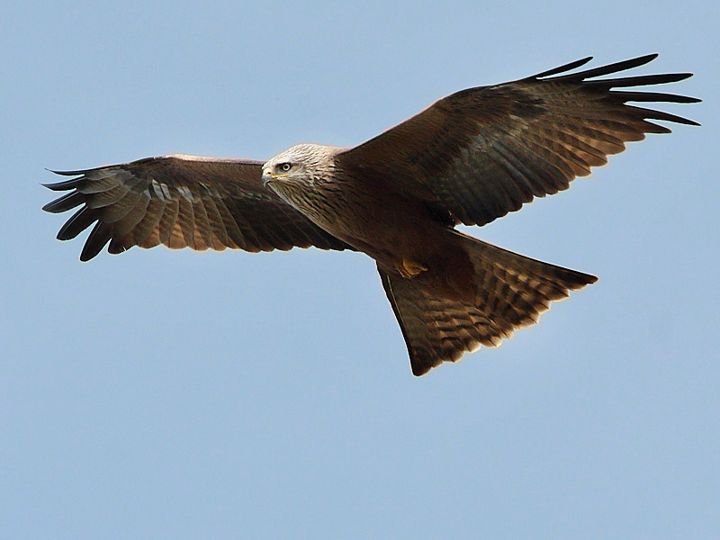
A medium-sized raptor with a wingspan of about 150 cm and an average weight of 735 g. Dark brown overall, paler on the head and neck with a dark patch behind the eye; pale brown below with dark streaks; black outer flight feathers. The angled wings and shallowly forked tail make it easy to identify in flight. Yellow cere and gape, black bill, yellow legs. A shrill whistle followed by a rapid whinnying call.
Habitat
Highly adaptable: near water, over grassland and forest, around harbours, fishing villages and cities. It glides on thermals in search of food, hunting but more often scavenging carrion and human refuse; gregarious outside the breeding season, roosting together.
Distribution
Across Eurasia, Africa and Australia and thought to be the world's most abundant accipitrid, with global estimates of up to 6.7 million. Common over Japan's port cities and the Chinese coast; scarce in Singapore.
Season and behaviour
Seen all year in Japan and eastern China, more obviously in winter flocks. Circles by day over coasts, estuaries and rubbish dumps; at Japanese tourist spots individuals dive to snatch food.
Photography tips
These are the FilmAnalysis editors' notes, not content from the sources.
Use continuous focus as it circles and take the moment it banks towards you, with the forked tail clear; overcast backlight makes a silhouette, so bright cloudy days are best. Harbour kites in Japan come very close, and 35–70 mm can place them in their surroundings. Never bait them with food.
Field ethics: keep a distance at which the bird does not change its behaviour; never approach or publish nest sites; no baiting, playback or flash; never clear vegetation around a nest; follow reserve rules and stay on paths.
Photographic styles
Open compositions of harbour and sky; the lines of circling.
Similar species
Red kite (slightly larger, deeper fork, rufous tones, Europe); yellow-billed kite (yellow bill, Africa); young osprey and buzzards fly differently and have no fork.
Related badge
None yet. No validated photo recognition exists for this species, so no badge is tied to it: a name in the encyclopedia is not evidence in a photograph.
The illustration is original FilmAnalysis artwork. The photograph is from Wikimedia Commons; its licence and author are under it.