PAL, NA (high Arctic to temperate n coasts, from Greenland, Iceland, w, nw Europe, Svalbard (n of Norway), n Siberian is. to Sakhalin, Kamchatka, Kuril and Commander is. (e Russia); Aleutian and Bering Sea is., w, sw Alaska mainland; Canadian high Arctic (ne Canada), Gulf of St. Lawrence and Newfoundland (se Canada))
IOC non-breeding range
w North Atlantic coast and coastal waters s to Virginia; mid-Atlantic Ridge to Azores; North Sea; Japan, Korean Pen., se Alaska to s California (USA)
Identification
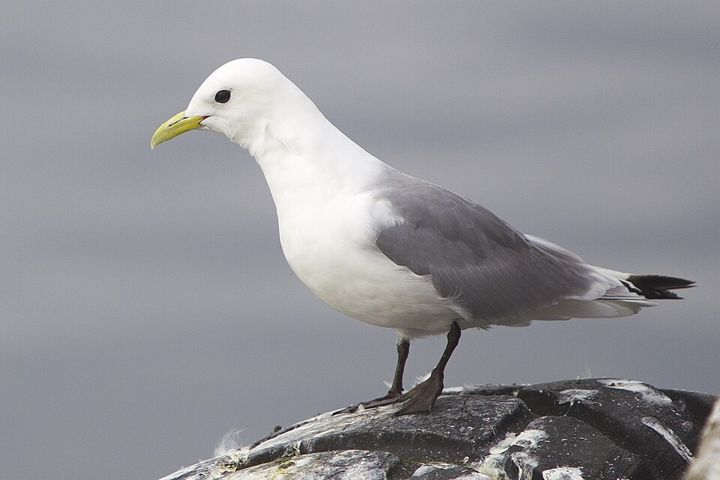
A medium-sized gull. Adults are pale grey above with white head and underparts and wingtips of solid black as if dipped in ink, without white spots; the bill is yellow without a red spot, the legs short and black, the eye dark. In winter a grey smudge on the nape. Juveniles have a black M across the wings, a black half-collar and a black tail band. The English name comes from its call, kittee-wa-aaake.
Habitat
The most pelagic of the gulls, almost always at sea except in the May to September breeding season, when it nests on the sheerest sea cliffs on the narrowest ledges.
Distribution
A coastal bird of Arctic and subarctic regions, across the northern Atlantic from Canada to Greenland and Europe and in the Pacific from Alaska to the Siberian coast; the winter range extends south to New Jersey, China, the Sargasso Sea and off West Africa. Common in winter off Japan, especially the north, and in small numbers off eastern China; absent from Singapore. Declining worldwide; listed as vulnerable.
Season and behaviour
Off northern Japan from November to March, with flocks in Hokkaido's fishing ports and along the coast; scattered off eastern China in winter. A buoyant flier over the sea that often follows fishing boats.
Photography tips
These are the FilmAnalysis editors' notes, not content from the sources.
The inky wingtips are the mark and the point of the picture: front-lit flight from a boat or breakwater at 1/2000 s. It flies more lightly than other gulls, so start tracking early. Grey winter sea and grey-white bird are one low-saturation tone, made for minimal compositions with empty space.
Field ethics: keep a distance at which the bird does not change its behaviour; never approach or publish nest sites; no baiting, playback or flash; never clear vegetation around a nest; follow reserve rules and stay on paths.
Photographic styles
Grey sea and white gull; the detail of ink-black wingtips.
Similar species
Black-headed gull (white leading edge, dark ear spot in winter, red legs); common gull (white spots in the black wingtips, yellow-green legs); the juvenile M pattern resembles a young little gull but is much larger.
Related badge
The album badge "a gull" unlocks when the vision model explicitly names a a gull in your photo and you rate the analysis. The badge stops at "a gull": it does not tell species apart, and this page existing unlocks nothing.
The illustration is original FilmAnalysis artwork. The photograph is from Wikimedia Commons; its licence and author are under it.