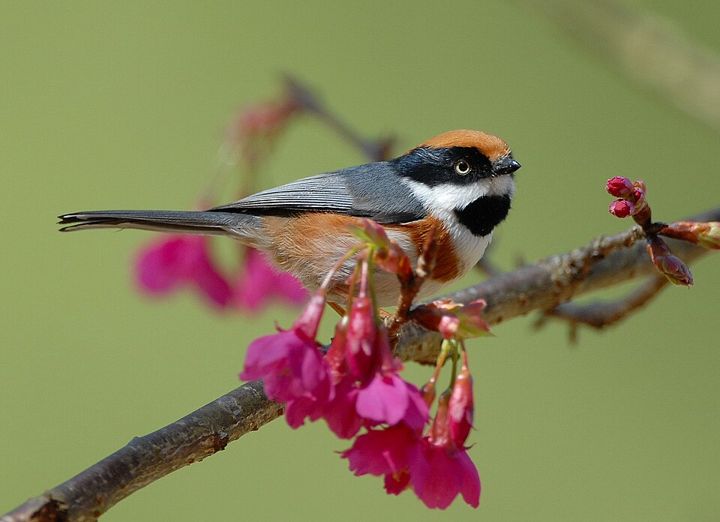
A very small passerine, about 10.5 cm long and 4–9 g. Subspecies vary a lot, but all have a medium-length tail (shorter than the long-tailed tit's), a black throat and a black bandit mask round the eye. The nominate race has a chestnut cap, breast band and flanks, dark grey back, wings and tail and a white belly; other races have grey caps or all-grey underparts without the band. Sexes alike.
Habitat
Scrub, woodland, forest edge, bamboo, tea gardens and city parks in low and middle hills, in flocks all year, streaming through the foliage like beads on a string after small insects; often with other small birds.
Distribution
From the Himalayan foothills across northern India, Bangladesh, Nepal, Bhutan, northern Myanmar to Vietnam and Taiwan, and in China from Tibet and the Yangtze basin, Sichuan east to coastal Jiangsu, north to Gansu, Shaanxi and southern Henan and south to Yunnan, Guizhou, Guangxi, Guangdong and Fujian (type locality Zhoushan, Zhejiang). Absent from Japan and Singapore.
Season and behaviour
Resident, seen all year; winter flocks are larger and easiest to meet in parks and at forest edges; nests from March to May in a bag of moss, lichen and spider silk.
Photography tips
These are the FilmAnalysis editors' notes, not content from the sources.
A passing flock gives two or three minutes: prefocus on an open branch on their line of travel and shoot bursts at 1/1250 s. The chestnut cap and black mask are clearest in soft front light and become a silhouette against the sky. They are tiny and even 600 mm needs cropping; do not chase the flock, it circles back.
Field ethics: keep a distance at which the bird does not change its behaviour; never approach or publish nest sites; no baiting, playback or flash; never clear vegetation around a nest; follow reserve rules and stay on paths.
Photographic styles
Miniature portraits on a twig; a neat scheme of chestnut, black and white.
Similar species
Long-tailed tit (very long tail, white head or black brow, no black throat); silver-throated bushtit (silver-grey face, south-west); black-browed bushtit (south-western mountains).
Related badge
None yet. No validated photo recognition exists for this species, so no badge is tied to it: a name in the encyclopedia is not evidence in a photograph.
The illustration is original FilmAnalysis artwork. The photograph is from Wikimedia Commons; its licence and author are under it.