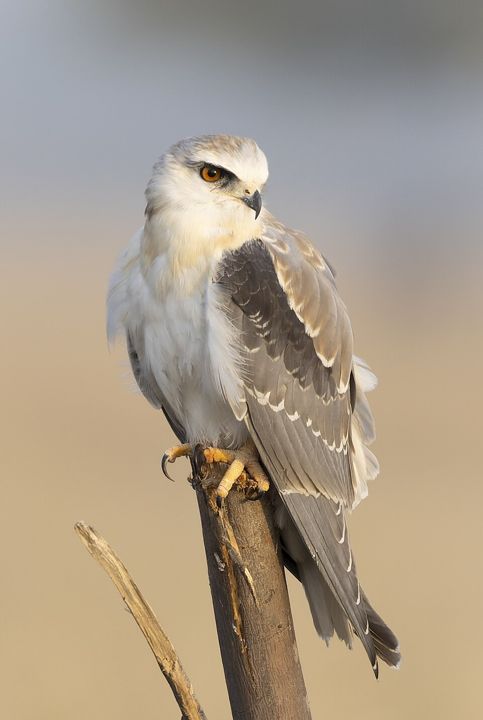
Singapore and tropical Asia, Japan and temperate East Asia
Habitat
towns and gardens
Colour
white, grey, black
Size
medium (20 to 50 cm)
IUCN status
Least Concern
IOC breeding range
PAL, AF, OR, AU (widespread)
Identification
A small diurnal raptor, mostly grey and white with black shoulder patches, wingtips and eye stripe. The long falcon-like wings extend past the tail when perched; in flight the tail is short and square, not forked like the Milvus kites. The large forward-facing eyes are red, shaded by a bony brow. On a roadside wire it jerks its tail up and down as if balancing. The sexes are alike.
Habitat
Open grassland, farmland, semi-desert and light woodland, hovering over fields like a kestrel for rodents and large insects; nests in trees.
Distribution
The Oriental region and Africa, with outposts in New Guinea, the Iberian Peninsula, the Nile valley and coastal North Africa; spreading noticeably in southern and eastern China and common over Singapore's open grass and reclaimed land; only a vagrant to Japan.
Season and behaviour
Resident and seen all year in the tropics and southern China, its numbers following the rodents. Hovers mainly at dawn and dusk and sits on wires and dead branches by day.
Photography tips
These are the FilmAnalysis editors' notes, not content from the sources.
In the hover it is steadier than a kestrel, and in side light the white wings and black shoulders are clean at 1/1600 s; the red eye needs a long lens at a wide aperture on a perched bird. In the evening it returns to the same wire or dead treetop: a silhouette against the warm sky with the detail of the red eye.
Field ethics: keep a distance at which the bird does not change its behaviour; never approach or publish nest sites; no baiting, playback or flash; never clear vegetation around a nest; follow reserve rules and stay on paths.
Photographic styles
Geometry of white and black; field silhouettes at dusk.
Similar species
The Australian black-shouldered kite and American white-tailed kite are close relatives whose ranges do not overlap; common kestrel (brown, similar hover); gulls have a different outline and do not hover.
Related badge
None yet. No validated photo recognition exists for this species, so no badge is tied to it: a name in the encyclopedia is not evidence in a photograph.
The illustration is original FilmAnalysis artwork. The photograph is from Wikimedia Commons; its licence and author are under it.