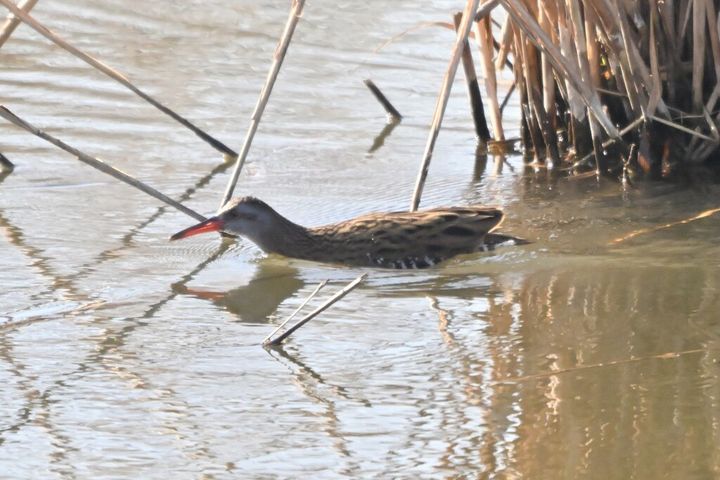
Photo: bko, via iNaturalist, public domain / CC0. Unmodified apart from resizing.
Region
Japan and temperate East Asia
Habitat
rivers and wetlands
Colour
brown, grey, red
Size
medium (20 to 50 cm)
IUCN status
Least Concern
IOC breeding range
PAL (e Siberia to Japan)
IOC non-breeding range
Nepal to se Asia and Borneo (rare)
Identification
23–29 cm long, 75–190 g. Paler above than the western water rail, with brown-tinged underparts, a brown stripe through the eye and a white throat; the long slightly decurved bill is red with a dark ridge; black-and-white barred flanks, brownish-red legs. Its calls differ from the western form and it is now usually treated as a full species, though nest and eggs are identical.
Habitat
Reed marsh, wet meadows, paddies and ditches, secretive, stepping along the edge of cover and flicking its tail constantly.
Distribution
Breeds in northern Mongolia, eastern Siberia, north-east China, Korea and northern Japan and winters in South-East Asia; in China it breeds in the north-east, Hebei and the north-west and winters in Fujian and Guangdong, and in Japan it winters from Honshu south. Only a rare vagrant in Singapore.
Season and behaviour
Winters in eastern China and central and southern Japan from October to March and breeds in the north from April to July. Comes out along the reed edge at dawn and dusk, with squealing and grunting calls.
Photography tips
These are the FilmAnalysis editors' notes, not content from the sources.
Wait at a gap in the reeds or along a ditch; at dawn it walks a short stretch of the edge. The red of the long bill and the barred flanks are clearest in side light; use high ISO and 1/500 s. After winter freezes it is forced into the open and is easiest to photograph, but do not chase it.
Field ethics: keep a distance at which the bird does not change its behaviour; never approach or publish nest sites; no baiting, playback or flash; never clear vegetation around a nest; follow reserve rules and stay on paths.
Photographic styles
A hidden figure at the reed edge; low winter browns.
Similar species
Water rail (the western species, darker above, grey below); slaty-breasted rail (chestnut crown, white spots above, southern China and Singapore).
Related badge
None yet. No validated photo recognition exists for this species, so no badge is tied to it: a name in the encyclopedia is not evidence in a photograph.
The illustration is original FilmAnalysis artwork. The photograph is from iNaturalist; its licence and author are under it.