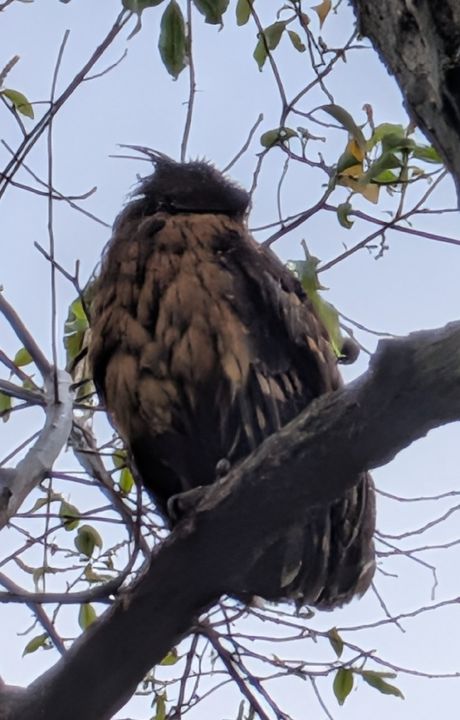
Photo: drtimk, via iNaturalist, public domain / CC0. Unmodified apart from resizing.
Region
Singapore and tropical Asia
Habitat
rivers and wetlands, forest, towns and gardens
Colour
brown, yellow
Size
medium (20 to 50 cm)
Identification
40 to 48 cm long, the smallest of the fish owls. Buff brown overall with darker tawny feathers on the back and broad blackish shaft streaks below. Prominent ear tufts stick out from the sides of the head; the face is paler with light brown brows and yellow eyes. Rounded wings, wings and tail broadly barred yellowish and dark brown, legs bare.
Habitat
Tropical forest and freshwater wetlands near rivers, lakes and fish ponds up to 1,600 m; also plantations and rural and urban gardens and parks.
Distribution
Bangladesh, Myanmar, Thailand, Malaysia and Singapore to Cambodia, Laos, Vietnam and the Sunda Islands; a non-breeding visitor to the Cocos (Keeling) Islands.
Season and behaviour
Resident. By day it usually roosts alone in dense foliage; from dusk it watches from the bank and swoops down like a fish eagle for fish, crabs, frogs, small reptiles and birds, and sometimes carrion. Pairs duet for minutes at a time before breeding.
Photography tips
These are the FilmAnalysis editors' notes, not content from the sources.
It roosts in dark, leafy crowns: use 400 mm or longer at a wide aperture and raise the ISO to keep 1/250 s or faster; a single focus point on the eye stops foreground leaves from stealing focus. Never use a flash or torch on it and never play calls; when it perches by water, wait at a distance for it to hunt.
Field ethics: keep a distance at which the bird does not change its behaviour; never approach or publish nest sites; no baiting, playback or flash; never clear vegetation around a nest; follow reserve rules and stay on paths.
Photographic styles
Low-key, low-contrast forest light; close portraits built around the eyes.
Similar species
Brown fish owl (larger, further north); the spotted wood owl, also in Singapore, has no ear tufts.
Related badge
The album badge "an owl" unlocks when the vision model explicitly names a an owl in your photo and you rate the analysis. The badge stops at "an owl": it does not tell species apart, and this page existing unlocks nothing.
The illustration is original FilmAnalysis artwork. The photograph is from iNaturalist; its licence and author are under it.
Why it is listed: this bird is named in the YouTube video description (波遊足跡 EP1) (the description text, not the subtitles). The video only shows that it was mentioned; names follow the IOC World Bird List 15.2 and the facts follow the sources below.