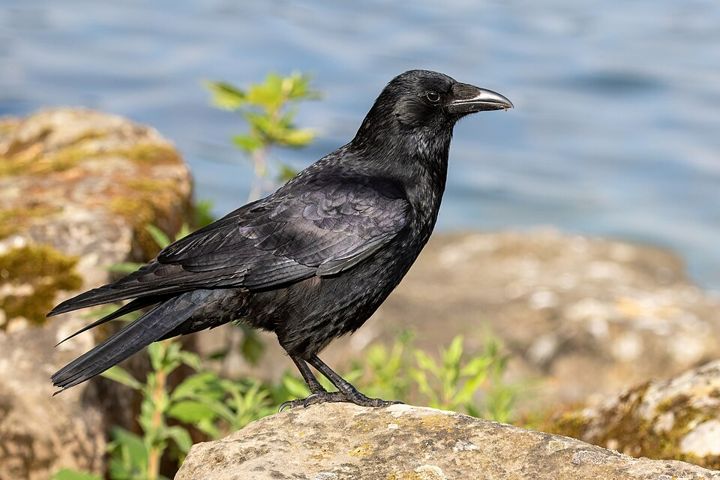
48–52 cm long, wingspan 84–100 cm, 400–600 g. Black with a green or purple sheen, bill, legs and feet black too; the bill is slimmer and straighter than the large-billed crow's and the forehead flatter. Much smaller than a raven, and less green in its gloss than a rook. Juveniles are brownish with blue eyes, darkening with age.
Habitat
Farmland, river beds, forest edge, parks and cities; extremely common in Japanese cities alongside the large-billed crow. Nests high in trees, eats almost anything, and drops nuts on roads for cars to crack.
Distribution
Western Europe and the eastern Palearctic; the eastern subspecies orientalis ranges across Central Asia, Siberia, northern and north-eastern China, Korea and Japan, with the hooded crow between. Common throughout Japan and in northern China in winter; absent from Singapore.
Season and behaviour
Resident, seen all year. Breeds March to June; in autumn and winter large flocks fly at dusk to fixed roosts, in Japanese cities sometimes thousands strong.
Photography tips
These are the FilmAnalysis editors' notes, not content from the sources.
An all-black bird is the hardest exposure: soft overcast light shows feather detail best, front light brings out the purple-green gloss, and backlight leaves a silhouette. Compress the evening roost flights between sky and buildings with a long lens. They are clever and wary: use a car or a long lens.
Field ethics: keep a distance at which the bird does not change its behaviour; never approach or publish nest sites; no baiting, playback or flash; never clear vegetation around a nest; follow reserve rules and stay on paths.
Photographic styles
Graphic black against sky; city crows at dusk.
Similar species
Large-billed crow (deep heavy bill, bulging forehead, deeper voice, the commoner city crow in East Asia); rook (bare grey-white bill base); raven (much larger, wedge tail).
Related badge
None yet. No validated photo recognition exists for this species, so no badge is tied to it: a name in the encyclopedia is not evidence in a photograph.
The illustration is original FilmAnalysis artwork. The photograph is from Wikimedia Commons; its licence and author are under it.