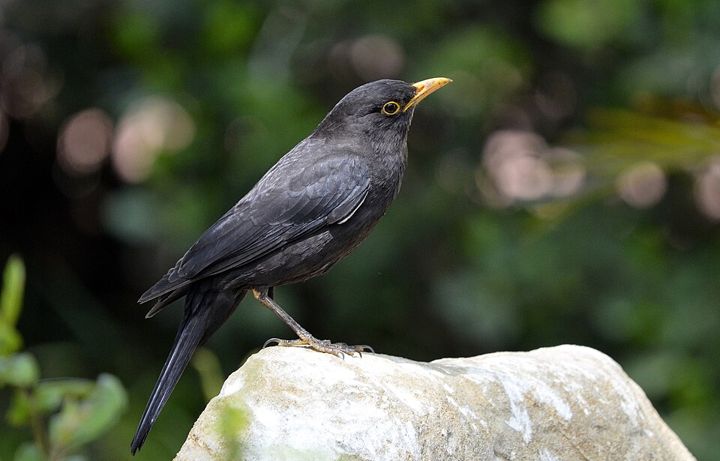
A medium-sized thrush. The male is all black with an orange-yellow bill and a yellow eye-ring; the female is dark brown with a faintly streaked throat and breast and a duller bill. Once treated as a subspecies of the common blackbird and now a species in its own right. A varied, mimicking voice, which gives its Chinese folk name hundred tongues.
Habitat
Parks, campuses, gardens, farmland and open woodland, hopping over lawns for earthworms and insects and also eating fruit; nests in trees and on buildings and is unafraid of people.
Distribution
Widespread across central and eastern China and one of the commonest birds in the cities of the Yangtze basin, its population probably still increasing; south to southern China, with a related species in Taiwan. Absent from mainland Japan and Singapore.
Season and behaviour
Resident, seen all year. Breeds from March to June, singing long and richly from treetops and roof ridges at dawn and dusk; small groups feed on lawns in winter.
Photography tips
These are the FilmAnalysis editors' notes, not content from the sources.
A black bird needs side light to have shape; the orange bill and yellow eye-ring are the only highlights, so focus on the eye. Its pause on a lawn, head tilted to listen for worms, is a fine pose from low down with a medium telephoto. The spring song silhouette on a ridge or treetop against first light is the other picture.
Field ethics: keep a distance at which the bird does not change its behaviour; never approach or publish nest sites; no baiting, playback or flash; never clear vegetation around a nest; follow reserve rules and stay on paths.
Photographic styles
A black figure on a city lawn; dawn silhouettes.
Similar species
Crows (much larger, black bill); grey-backed and Japanese thrushes (males with grey breast and orange flanks); crested myna (crest, white wing patches).
Related badge
None yet. No validated photo recognition exists for this species, so no badge is tied to it: a name in the encyclopedia is not evidence in a photograph.
The illustration is original FilmAnalysis artwork. The photograph is from Wikimedia Commons; its licence and author are under it.