PAL (islands off Zhejiang and Fujian (e China coast))
IOC non-breeding range
Philippines, Borneo, Halmahera (n Moluccas) and Seram (ec Moluccas; few records anywhere)
Identification
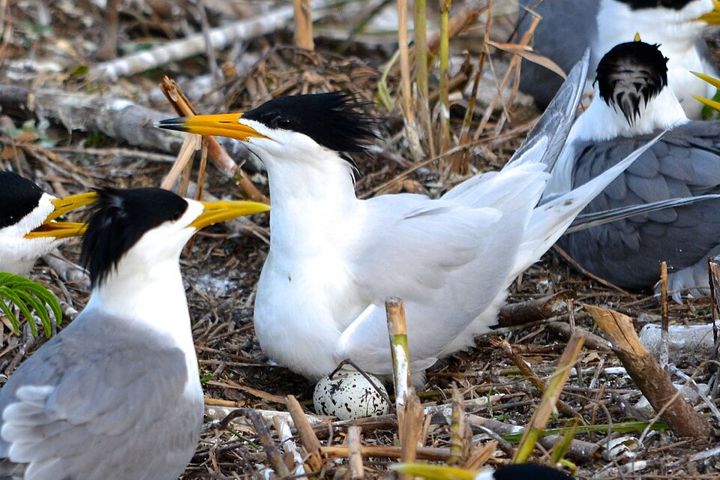
A medium-large tern, 38–43 cm long, closely similar to sandwich, Cabot's and lesser crested terns. The bill is yellow with a black tip (the reverse of the sandwich tern's) and stouter, with a tiny white point beyond the black seen close up; in the breeding season a full black crown, pale silvery-grey back and wings, white tail and white rump. Smaller and much paler-backed than its closest relative the greater crested tern, whose bill is all yellow and forehead white when breeding.
Habitat
Breeds on uninhabited offshore islets, always within colonies of greater crested terns; fishes inshore and rests on sandbars and buoys.
Distribution
Breeds only on islands off Zhejiang (Jiushan and Wuzhishan) and Fujian (Matsu) in China; very few non-breeding records, from the Philippines, Borneo and the Moluccas. Thought possibly extinct until rediscovered on Matsu in 2000; about a hundred or so remain, critically endangered, and the county bird of Lienchiang. Absent from Japan and Singapore.
Season and behaviour
Breeds on the Zhejiang and Fujian coast from May to August and leaves after September; it is the black-tipped bill in the greater crested tern colony, with protection and decoy-attraction schemes at the colonies.
Photography tips
These are the FilmAnalysis editors' notes, not content from the sources.
The breeding islets are reserves and cannot be landed on: photograph from an official boat at distance or wait on nearby flats where they feed. Among greater crested terns look for the black bill tip and paler back, with a long lens and teleconverter at 1/2000 s. Avoid anything that could disturb the colony; this bird cannot afford one failed season.
Field ethics: keep a distance at which the bird does not change its behaviour; never approach or publish nest sites; no baiting, playback or flash; never clear vegetation around a nest; follow reserve rules and stay on paths.
Photographic styles
White terns among islands and surf; the detail of a black bill tip.
Similar species
Greater crested tern (larger, all-yellow bill, dark grey back, white forehead when breeding); lesser crested tern (orange bill, grey rump); sandwich tern (black bill with yellow tip, Europe and West Asia).
Related badge
The album badge "a gull" unlocks when the vision model explicitly names a a gull in your photo and you rate the analysis. The badge stops at "a gull": it does not tell species apart, and this page existing unlocks nothing.
The illustration is original FilmAnalysis artwork. The photograph is from Wikimedia Commons; its licence and author are under it.