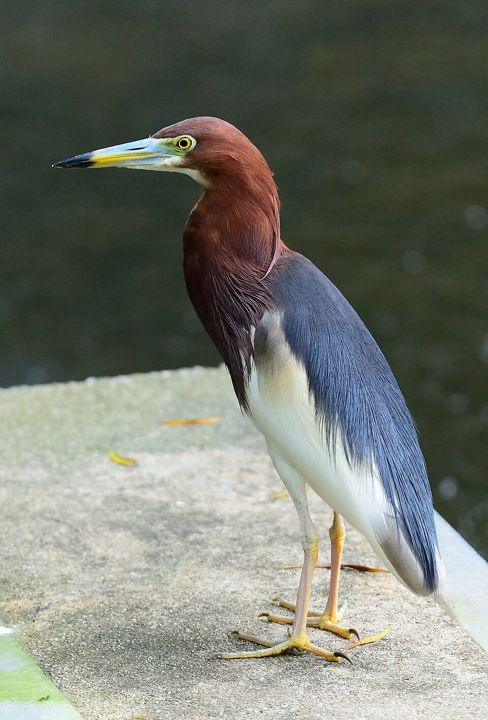
Photo: https://www.flickr.com/photos/uncle_1389/, via Wikimedia Commons, licensed CC BY-SA 2.0. Unmodified apart from resizing.
Region
Singapore and tropical Asia, Japan and temperate East Asia
Habitat
rivers and wetlands
Colour
white, brown, red
Size
medium (20 to 50 cm)
IUCN status
Least Concern
IOC breeding range
PAL, OR (Assam (ne India) and n Myanmar through Russian Far East, Japan and s China)
IOC non-breeding range
Andaman Is. e to Ryukyu Is. (s Japan) s to Greater Sundas
Identification
About 47 cm. White wings, a yellow bill with a black tip, yellow eyes and legs. In breeding plumage the head and neck are deep chestnut and the back slaty blue like a cape, in sharp contrast with the white wings; at other times it is greyish brown streaked with white and inconspicuous until it takes off and the white wings suddenly appear.
Habitat
Shallow fresh and salt wetlands: paddies, ponds, ditches, river beds, mangrove edges and park waters; a lowland bird. Usually stands alone and motionless at the water's edge waiting for fish and insects.
Distribution
China and adjacent temperate and subtropical East Asia, from Assam and northern Myanmar through central and southern China to the Russian Far East and Japan; winters south to the Andamans, the Ryukyus and the Greater Sundas. Very common in China's paddies, a winter visitor to Singapore, and mainly in southern Japan.
Season and behaviour
All year in eastern and southern China, in breeding dress from April to July; in Singapore from September to April. Gives a low croak on take-off.
Photography tips
These are the FilmAnalysis editors' notes, not content from the sources.
It stands still, ideal for a long-lens portrait: the chestnut and slate of breeding plumage saturate in side light. The take-off, white wings opening, is the highlight all year: watch for the forward lean and use 1/1600 s. Paddy reflections and planting-season fields are a background particular to China.
Field ethics: keep a distance at which the bird does not change its behaviour; never approach or publish nest sites; no baiting, playback or flash; never clear vegetation around a nest; follow reserve rules and stay on paths.
Photographic styles
Rural colour of paddies and reflections; a flash of white.
Similar species
Indian pond heron (pale yellow-brown head and neck in breeding plumage, South Asia); Javan pond heron (buff head, chestnut breast, South-East Asia); outside the breeding season the three are nearly inseparable.
Related badge
None yet. No validated photo recognition exists for this species, so no badge is tied to it: a name in the encyclopedia is not evidence in a photograph.
The illustration is original FilmAnalysis artwork. The photograph is from Wikimedia Commons; its licence and author are under it.