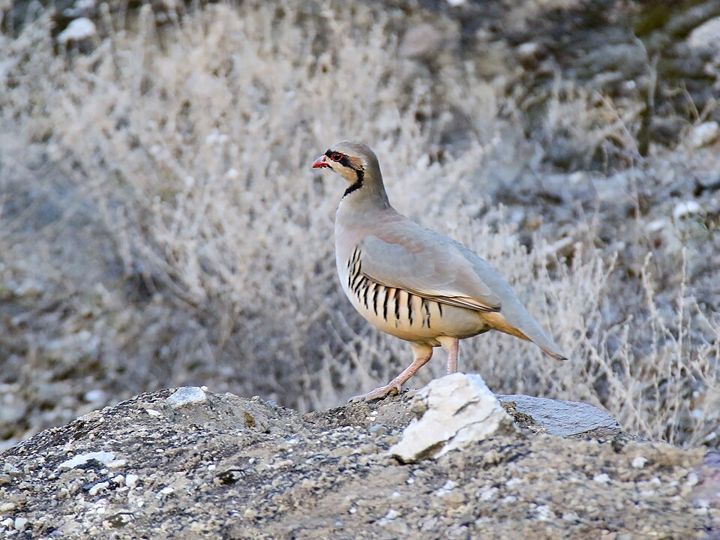
Photo: Imran Shah from Islamabad, Pakistan, via Wikimedia Commons, licensed CC BY-SA 2.0. Unmodified apart from resizing.
Region
Japan and temperate East Asia
Habitat
towns and gardens
Colour
brown, grey, red
Size
medium (20 to 50 cm)
IUCN status
Least Concern
IOC breeding range
PAL (s)
Identification
A rotund partridge 32–35 cm long with a light brown back, grey breast and buff belly; white face with a black band running from the forehead across the eye down to form a necklace enclosing the white throat; boldly black-and-white barred flanks, red legs and a coral-red bill. Sexes alike, the female slightly smaller and lacking the spur. A noisy chuck-chuck-chukar-chukar, from which the name comes.
Habitat
Dry low-mountain valleys, rocky and sandy hill slopes, semi-desert and field edges, running in coveys on the ground and bursting into a downhill glide when flushed.
Distribution
Native to south-eastern Europe, West and Central Asia, southern Siberia, Afghanistan, Kashmir and China's Xinjiang, Qinghai and Gansu through northern China to the south-west of the north-east; introduced as a gamebird to western North America, Hawaii and New Zealand. Absent from Japan and Singapore.
Season and behaviour
Resident, seen all year; winter coveys come down to the foot of the hills and farmland, easiest on bare south slopes after snow; breeds from April to June, calling from rocks at dawn.
Photography tips
These are the FilmAnalysis editors' notes, not content from the sources.
Wary, and a runner rather than a flier: search slowly by car along hill roads and never get out to chase. The red bill and legs, black necklace and barred flanks are best in a front-lit profile; calling from a rock at dawn is the one time it stays put. With a loess slope behind, put the bird in light and the slope in shade.
Field ethics: keep a distance at which the bird does not change its behaviour; never approach or publish nest sites; no baiting, playback or flash; never clear vegetation around a nest; follow reserve rules and stay on paths.
Photographic styles
A round partridge on loess slopes; detail of red bill and black necklace.
Similar species
Przevalski's partridge (slightly larger, a ring of chestnut spots below the necklace, endemic to north-west China); rock partridge (Europe, no overlap); red-legged partridge (necklace breaking into streaks on the breast, western Europe).
Related badge
None yet. No validated photo recognition exists for this species, so no badge is tied to it: a name in the encyclopedia is not evidence in a photograph.
The illustration is original FilmAnalysis artwork. The photograph is from Wikimedia Commons; its licence and author are under it.