Japan and temperate East Asia, Singapore and tropical Asia
Habitat
forest, towns and gardens
Colour
grey, black, white
Size
small (under about 20 cm)
IOC breeding range
OR, PAL, AU (s, e, se Asia to e Lesser Sundas)
Identification
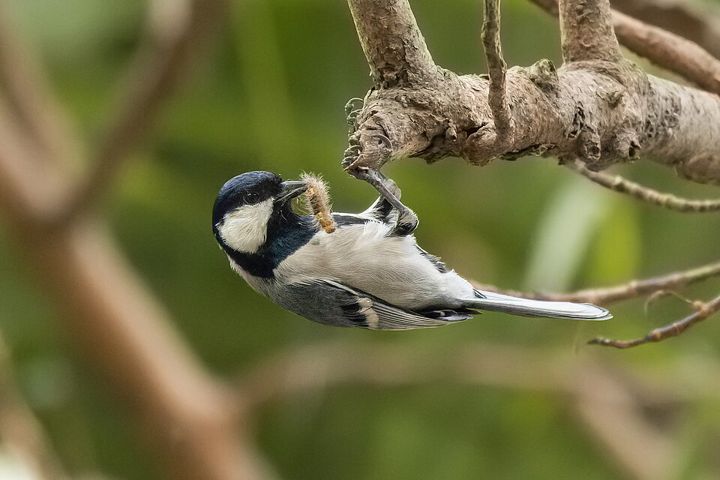
A typical tit without a crest. Black head with a large white cheek patch, grey back, one white wing-bar, white underparts with a black line running down the middle of the breast and belly; the female's line is narrower and duller. Juveniles show some green on the back and yellow below. Made up of grey-backed populations once treated as subspecies of the great tit; the Japanese tit is now grouped here too.
Habitat
Woodland of all kinds, forest edge, parks, gardens and city greenery, often in mixed flocks gleaning insects among the leaves; takes readily to nest boxes.
Distribution
From West Asia across South Asia into South-East and East Asia, east to the Lesser Sundas; one of the commonest tits in eastern China and throughout Japan. Absent from Singapore, reaching only the northern Malay Peninsula.
Season and behaviour
Resident and seen all year; sings most from March to May, a repeated two-note tsee-tsee-hey. In winter it joins mixed flocks with long-tailed tits and white-eyes.
Photography tips
These are the FilmAnalysis editors' notes, not content from the sources.
It never stops: 1/1000 s or faster, bursts, and prefocus on a perch it keeps returning to. The white cheek and black head look cleanest in soft overcast light. Nest boxes in winter and newly flowering cherry and plum branches in spring give the easiest pictures.
Field ethics: keep a distance at which the bird does not change its behaviour; never approach or publish nest sites; no baiting, playback or flash; never clear vegetation around a nest; follow reserve rules and stay on paths.
Photographic styles
Black, white and grey on a branch; the light Japanese palette.
Similar species
Great tit (western Eurasia, green back and yellow underparts); the Japanese tit is often treated as the same species; green-backed tit (green back, yellow below, two wing-bars).
Related badge
None yet. No validated photo recognition exists for this species, so no badge is tied to it: a name in the encyclopedia is not evidence in a photograph.
The illustration is original FilmAnalysis artwork. The photograph is from Wikimedia Commons; its licence and author are under it.