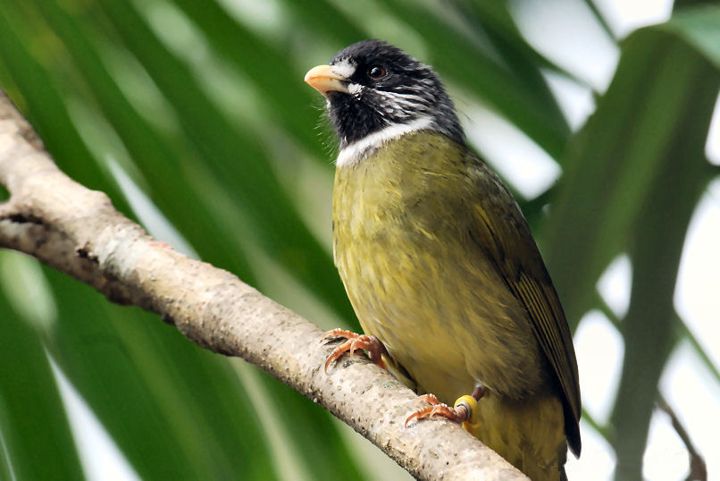
A thick-billed bulbul: the bill short, deep and ivory white like a finch's. Black head with fine white streaks on the cheeks and a white half-collar on the foreneck that gives the name; olive green above, yellow-green below, with a black band at the tail tip. A loud voice.
Habitat
Forested hills at moderate elevations, forest edge, scrub, bamboo, tea gardens and orchards near villages; mainly a fruit-eater that also takes seeds and insects; monogamous, the female building the nest in a tree.
Distribution
Southern and central China (Gansu, Sichuan, Yunnan, Shaanxi, Henan and the provinces south of the Yangtze; type locality the hills north of Fuzhou), northern Vietnam and Taiwan, with a few records from southern Japan. Absent from Singapore.
Season and behaviour
Resident, seen all year; winter flocks on fruit trees and scrub, breeding from April to June and calling from treetops at dawn.
Photography tips
These are the FilmAnalysis editors' notes, not content from the sources.
The white thick bill and collar on a black head are a ready focus, clearest in front light; the olive body saturates only against a dark green slope. It stays a while on bush tops and small trees, so a long lens from slightly below works. Flocks are densest when fruit trees are in season.
Field ethics: keep a distance at which the bird does not change its behaviour; never approach or publish nest sites; no baiting, playback or flash; never clear vegetation around a nest; follow reserve rules and stay on paths.
Photographic styles
Green with black and white in the southern hills; a thick-billed portrait.
Similar species
Crested finchbill (forward black crest, no white collar, Yunnan and Sichuan); black bulbul (red bill, black or grey body).
Related badge
None yet. No validated photo recognition exists for this species, so no badge is tied to it: a name in the encyclopedia is not evidence in a photograph.
The illustration is original FilmAnalysis artwork. The photograph is from Wikimedia Commons; its licence and author are under it.