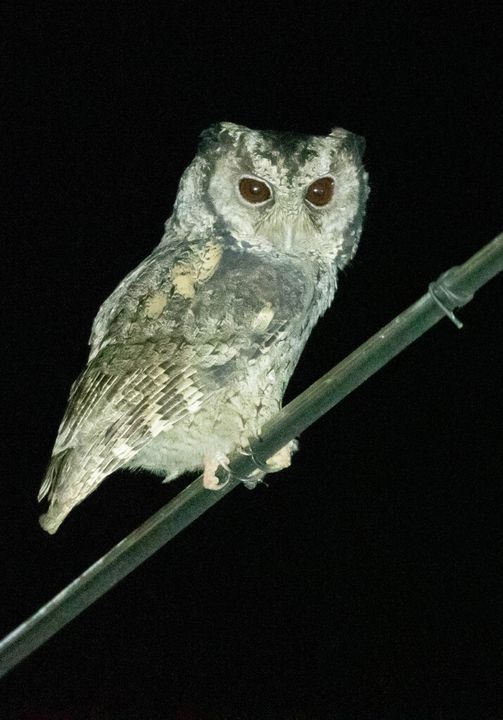
Photo: Sunny Zhang 张迎新, via iNaturalist, public domain / CC0. Unmodified apart from resizing.
Region
Singapore and tropical Asia
Habitat
forest
Colour
grey, brown
Size
medium (20 to 50 cm)
Identification
23 to 25 cm, the largest of the scops owls, with small ear tufts. Upperparts grey or brown by subspecies with faint buff spots; underparts buff with fine dark streaks. The facial disc is whitish or buff, the eyes orange or brown, and there is a buff neckband. Sexes alike; the flight is deeply undulating.
Habitat
Forest and well-wooded country; nests in tree hollows and lays three to five eggs.
Distribution
Resident from northern Pakistan, northern India, Nepal and Bangladesh along the Himalayas east to southern China and the island of Taiwan; some birds migrate to winter in India, Sri Lanka and Malaysia.
Season and behaviour
Nocturnal and mainly insectivorous; the call is a quiet 'goog gook'. Roosting by day it is often mobbed by small birds, and the commotion is the best way to find it.
Photography tips
These are the FilmAnalysis editors' notes, not content from the sources.
When small birds mob it, it usually just sits tight: stay well back with a long lens and a wide aperture to melt the foreground leaves, focusing on the eye. Do not follow the mobbing flock in, never use playback, and no flash at night.
Field ethics: keep a distance at which the bird does not change its behaviour; never approach or publish nest sites; no baiting, playback or flash; never clear vegetation around a nest; follow reserve rules and stay on paths.
Photographic styles
Portraits through softened foreground leaves.
Similar species
Sunda scops owl (dark eyes); Indian scops owl (slightly smaller, best told by voice); Oriental scops owl.
Related badge
The album badge "an owl" unlocks when the vision model explicitly names a an owl in your photo and you rate the analysis. The badge stops at "an owl": it does not tell species apart, and this page existing unlocks nothing.
The illustration is original FilmAnalysis artwork. The photograph is from iNaturalist; its licence and author are under it.
Why it is listed: this bird is named in the YouTube video description (波遊足跡 EP1) (the description text, not the subtitles). The video only shows that it was mentioned; names follow the IOC World Bird List 15.2 and the facts follow the sources below.