Singapore and tropical Asia, Japan and temperate East Asia
Habitat
coast and mangroves, rivers and wetlands
Colour
grey, white, green
Size
medium (20 to 50 cm)
IUCN status
Least Concern
IOC breeding range
PAL (inland and coastal subarctic to temperate taiga wetlands of Palearctic: n Europe to e Siberia: Scotland, Scandinavia and Baltic states e through temperate Russia to Chukotskiy Pen., Kamchatka and Amurland (se Russia))
IOC non-breeding range
sw PAL, AF, OR, AU : inland and coastal s temperate to tropical Old World: sw, s Europe, Canary and Cape Verde is. (Macaronesia, w of n Africa), Africa, Malagasy region, Middle East, s, se Asia to e China, Indonesian Arch., New Guinea region, Australia and Tasmania, Taiwan, Korean Pen., c, s Japan, Mariana Is. and Palau (w Micronesia)
Identification
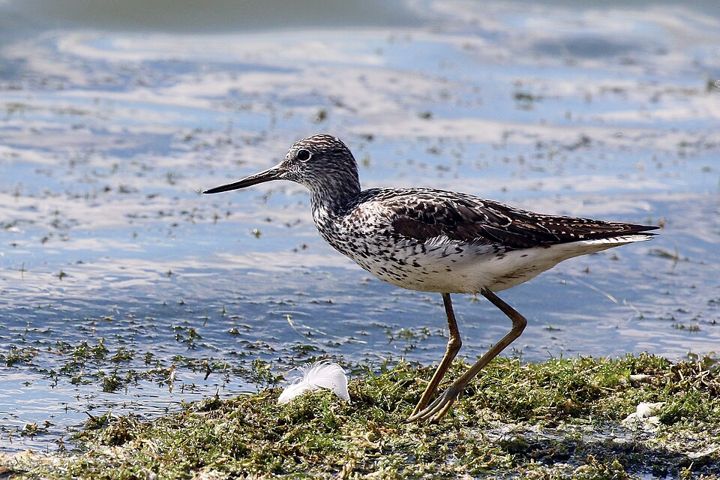
A large wader, somewhat bigger than the common redshank. Brown and streaked in breeding plumage, grey-brown in winter, white below; long greenish legs and a long bill with a grey base that looks slightly upturned. In flight a white wedge runs up the back. The usual call is a rapid series of three short fluty notes, teu-teu-teu.
Habitat
Breeds on dry ground near marshes in the subarctic taiga; on passage and in winter on fresh and coastal wetlands, from estuary mud and salt pans to fish ponds and reservoir margins, usually wading in shallow water.
Distribution
Breeds from northern Scotland and Scandinavia east across Siberia to Kamchatka and the Amur; winters in Africa, the Indian subcontinent, South-East Asia, eastern China, Taiwan, central and southern Japan and Australasia. A common winter visitor and passage migrant on the coasts of Singapore and southern China.
Season and behaviour
In Singapore and south-east China seen from August to May, peaking on passage in April–May and August–October. Usually alone or in loose groups, dashing through the shallows after small fish and invertebrates.
Photography tips
These are the FilmAnalysis editors' notes, not content from the sources.
It runs through shallow water chasing fish: 1/1600 s or faster and bursts catch the splash. Side light gives the grey-and-white plumage and green legs their depth. A rising tide pushes them towards the shore and is the easiest time to get close; shoot low along the mud so the glare on the water becomes the background.
Field ethics: keep a distance at which the bird does not change its behaviour; never approach or publish nest sites; no baiting, playback or flash; never clear vegetation around a nest; follow reserve rules and stay on paths.
Photographic styles
Grey-and-white minimalism on the flats; splashes of movement.
None yet. No validated photo recognition exists for this species, so no badge is tied to it: a name in the encyclopedia is not evidence in a photograph.
The illustration is original FilmAnalysis artwork. The photograph is from Wikimedia Commons; its licence and author are under it.