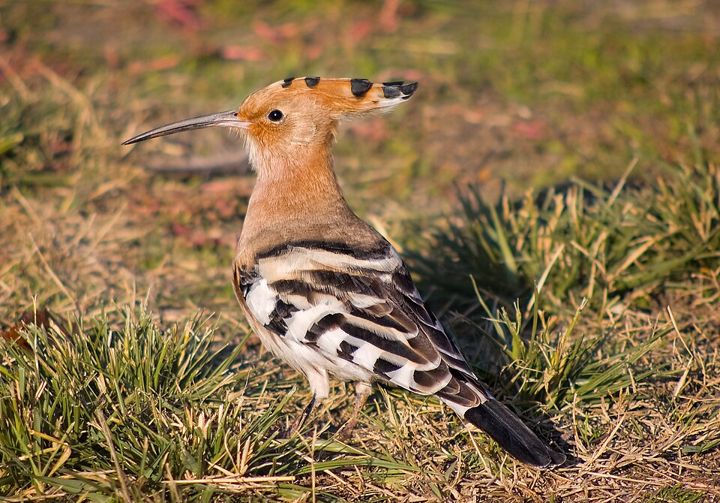
25–32 cm long, wingspan 44–48 cm. Unmistakable: a cinnamon body, black-and-white barred wings and tail with a broad white band across the black tail; a tall erectile crest with black tips that fans open on landing; a long thin downcurved black bill with a fawn base. It flies like a huge butterfly, half closing the wings after each few beats. The call is a soft oop-oop-oop.
Habitat
Open country, lawns, orchards, parks and temple courtyards, probing short grass with the long bill for insect larvae; nests in tree holes, wall crevices and holes in buildings.
Distribution
Native to Europe, Asia and Africa and the most widespread hoopoe; northern populations migrate. Common over most of China, even on lawns in northern cities; a scarce passage migrant in Japan and only a vagrant in Singapore.
Season and behaviour
Seen all year in eastern China, breeding in the north from April to September and wintering in the south. Easiest to approach while feeding on grass in spring; the crest fans fully the instant it lands.
Photography tips
These are the FilmAnalysis editors' notes, not content from the sources.
The crest opens only for a second or two on landing or in alarm: prefocus and shoot bursts. The cinnamon is truest in soft front light; the black-and-white wings in flight are a butterfly at 1/2000 s. Absorbed in probing a lawn it allows a close approach: crouch and edge forward so the foreground grass blurs away.
Field ethics: keep a distance at which the bird does not change its behaviour; never approach or publish nest sites; no baiting, playback or flash; never clear vegetation around a nest; follow reserve rules and stay on paths.
Photographic styles
Warm portraits on grass; graphic black-and-white stripes.
Similar species
No similar species; the Madagascar hoopoe was once treated as a subspecies.
Related badge
None yet. No validated photo recognition exists for this species, so no badge is tied to it: a name in the encyclopedia is not evidence in a photograph.
The illustration is original FilmAnalysis artwork. The photograph is from Wikimedia Commons; its licence and author are under it.