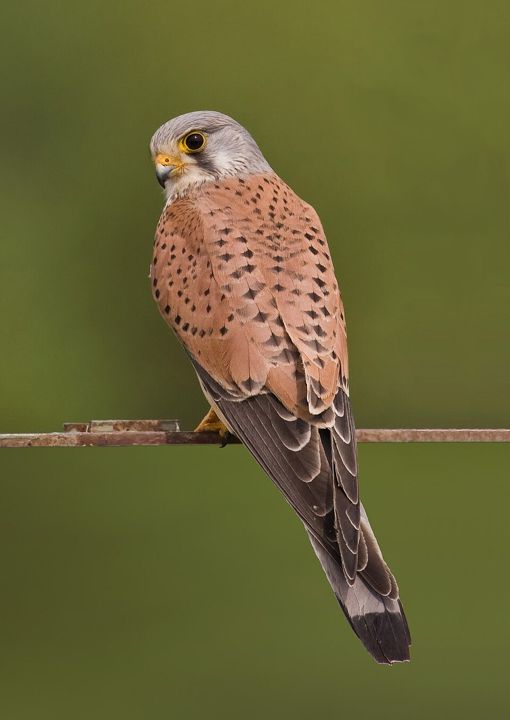
A small falcon, 32–39 cm long with a wingspan of 65–82 cm, the female noticeably larger. Long wings and a long tail. Light chestnut-brown above with blackish spots, buff below with narrow black streaks, blackish flight feathers. The sexes differ: the male has fewer spots and a blue-grey cap and tail with a black band at the tip; the female's tail is brown with black bars. Its signature is hovering into the wind with the head held perfectly still, watching the ground.
Habitat
Woodland edge, grassland, farmland with scattered trees, coasts and cities; nests on cliffs, in trees, in old buildings and in niches on tall blocks.
Distribution
Native across Europe, Asia and Africa, occasionally reaching the east coast of North America. Common throughout China and Japan, breeding in cities too; only a rare vagrant in Singapore.
Season and behaviour
Seen all year in eastern China and Japan, with more northern birds in winter. Hovers for small mammals, lizards and large insects and perches on wires and lamp posts.
Photography tips
These are the FilmAnalysis editors' notes, not content from the sources.
In the hover the head is fixed, so 1/1600 s gives a sharp body and gently blurred wingtips; stand facing the direction it hovers into. Birds on wires can be approached slowly using a car as a hide. The male's blue-grey head and tail show their colour only in side light.
Field ethics: keep a distance at which the bird does not change its behaviour; never approach or publish nest sites; no baiting, playback or flash; never clear vegetation around a nest; follow reserve rules and stay on paths.
Photographic styles
A moment held still in the air; empty field and sky.
Similar species
Lesser kestrel (slightly smaller, unspotted back in the male, white claws); Eurasian hobby (longer pointed wings, heavy streaks below, rufous thighs).
Related badge
None yet. No validated photo recognition exists for this species, so no badge is tied to it: a name in the encyclopedia is not evidence in a photograph.
The illustration is original FilmAnalysis artwork. The photograph is from Wikimedia Commons; its licence and author are under it.