Singapore and tropical Asia, Japan and temperate East Asia
Habitat
rivers and wetlands
Colour
black, red, yellow
Size
medium (20 to 50 cm)
IUCN status
Least Concern
IOC breeding range
PAL, AF, IO, OR, PO (widespread)
Identification
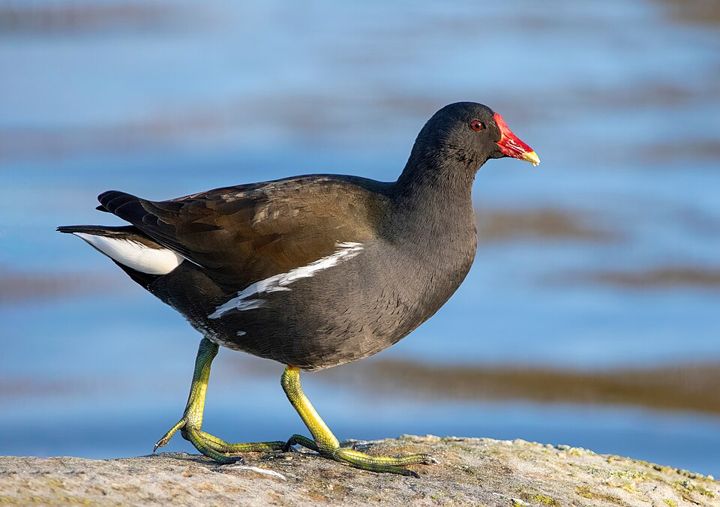
About 30–38 cm. Mostly black and dark brown with a white line along the flank and white under the tail, flicked up as it swims and bobs its head; the frontal shield and bill base are bright red, the bill tip yellow, the legs yellow-green with very long toes. Juveniles are browner and lack the red shield. A wide range of gargling calls and a loud hiss when threatened.
Habitat
Well-vegetated marshes, ponds, canals, paddies and other wetlands; absent from polar regions and most rainforest. Walks on floating vegetation and comes ashore to graze.
Distribution
Across much of the Old World, in Africa, Europe and Asia, and one of the commonest rails. Common on wetlands and in city parks in China and Japan, with a steady population in Singapore's marshes and reservoirs.
Season and behaviour
Seen all year; northern birds move south in winter. Almost always at the water's edge, head bobbing as it swims and high-stepping on land. In the breeding season the black, red-crowned chicks follow the adults over the water.
Photography tips
These are the FilmAnalysis editors' notes, not content from the sources.
The red shield is the point of the picture and shows best on dark water in side or back light; a little negative compensation keeps detail in the black plumage. Photograph the feet on lotus leaves or duckweed: the long toes are the interest. Black chicks with red crowns are most plentiful from May to August.
Field ethics: keep a distance at which the bird does not change its behaviour; never approach or publish nest sites; no baiting, playback or flash; never clear vegetation around a nest; follow reserve rules and stay on paths.
Photographic styles
One point of red on dark water; small waterside scenes.
Similar species
Eurasian coot (all black with a white shield and bill); purple swamphen (blue-purple, much larger); the American common gallinule is near-identical but with a differently shaped shield.
Related badge
None yet. No validated photo recognition exists for this species, so no badge is tied to it: a name in the encyclopedia is not evidence in a photograph.
The illustration is original FilmAnalysis artwork. The photograph is from Wikimedia Commons; its licence and author are under it.