NA, PAL (subarctic to temperate (locally Arctic) n coasts)
IOC non-breeding range
to Virginia in Gulf Stream (w North Atlantic); to Iberian Pen. (e North Atlantic); to n Japan (w North Pacific); to nw Baja California (nw Mexico; e North Pacific)
Identification
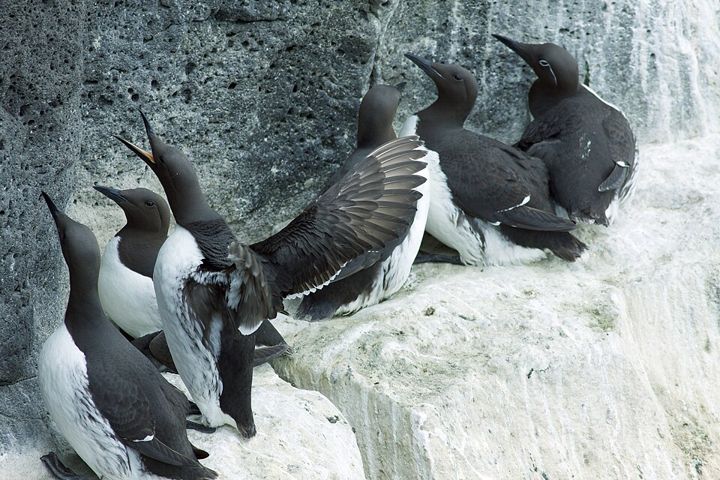
A large auk, 38–46 cm long with a 61–73 cm wingspan and weighing about 945–1,044 g. In breeding plumage black on the head, back and wings (dark brown in southern races) and white below; a thin dark pointed bill and a small rounded black tail. After the post-breeding moult the face is white with a dark spur behind the eye and the flanks often streaked dark. Legs and bill dark grey. Fast in direct flight but not agile; underwater it flies with its wings, typically diving to 30–60 m and as deep as 180 m.
Habitat
Inshore and offshore cold waters, coming to land only to breed on cliff ledges and islands in extremely dense colonies, the single pear-shaped egg laid straight onto rock.
Distribution
Circumpolar in low-Arctic and boreal waters of the North Atlantic and North Pacific; Pacific birds breed on the Kurils and at Teuri off Hokkaido and winter south to northern Japan. Seen off northern Japan in winter; absent from China and Singapore. Lives about 20 years.
Season and behaviour
Off northern Japan from November to April; breeds at Teuri and elsewhere from May to August, the Hokkaido colonies once greatly reduced and now recovering.
Photography tips
These are the FilmAnalysis editors' notes, not content from the sources.
Birds at sea are shot from a boat, the black and white softest under cloud at 1/2000 s; the leap before a dive and the shake on surfacing are the action moments. Breeding cliffs are photographed from the viewpoints with a long lens, the packed standing birds making patterns; never take a boat under the cliff to disturb them.
Field ethics: keep a distance at which the bird does not change its behaviour; never approach or publish nest sites; no baiting, playback or flash; never clear vegetation around a nest; follow reserve rules and stay on paths.
Photographic styles
Patterns of black-and-white birds standing on sea cliffs; small silhouettes on grey sea.
Similar species
Thick-billed murre (shorter heavier bill with a white line at the base, unstreaked flanks when breeding); marbled and ancient murrelets (much smaller).
Related badge
None yet. No validated photo recognition exists for this species, so no badge is tied to it: a name in the encyclopedia is not evidence in a photograph.
The illustration is original FilmAnalysis artwork. The photograph is from Wikimedia Commons; its licence and author are under it.