Singapore and tropical Asia, Japan and temperate East Asia
Habitat
rivers and wetlands, coast and mangroves
Colour
brown, white
Size
small (under about 20 cm)
IUCN status
Least Concern
IOC breeding range
PAL (widespread, subarctic to temperate inland waterbody margins of Palearctic: British Isles n to Scandinavia s to Iberian Pen., e through temperate Russia to ec Chukotskiy Pen. (ne Russia), s from Turkey, Caucasus, Iran, c Asia to Kashmir (nw Himalayas), n Mongolia, ne China and Japan)
IOC non-breeding range
AF, OR, AU, also Middle East : tropical to subtropical inland and coastal waterbodies of Paleotropics: sw Europe, s Macaronesia (nw of w Africa), Africa, Malagasy region, s Middle East, s, se Asia, Indonesian Arch., Philippines, Taiwan, e China, s Japan, New Guinea, Australia, Bismarck Arch. to Vanuatu, New Caledonia, and Micronesia
Identification
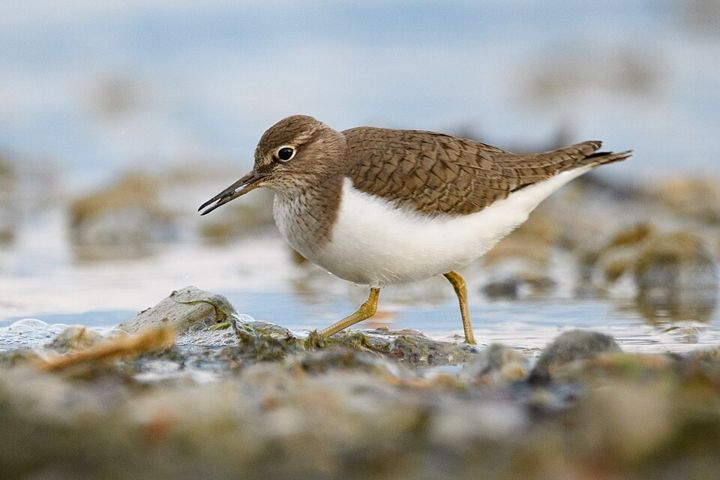
18–20 cm long, wingspan 32–35 cm. Greyish-brown above, white below, the white curling up in front of the folded wing as a distinct hook; short dull-yellow legs; a bill with a pale base and dark tip. It bobs its tail constantly when standing and flies low over the water on stiff, flickering wings with glides between, showing a white wing-bar. Winter birds are duller; juveniles have buff edges to the wing feathers.
Habitat
Breeds on the margins of subarctic to temperate inland waters: rivers, lakeshores and stony streams. On migration and in winter it uses almost any inland or coastal water, from reservoirs and fish ponds to mangrove mud and city canals.
Distribution
Breeds across the Palearctic from the British Isles and Scandinavia east to the Chukotka Peninsula, south to Turkey, Central Asia, the north-west Himalayas, northern Mongolia, north-east China and Japan; winters in Africa, South and South-East Asia, eastern China, southern Japan, New Guinea and Australia. A common winter visitor and passage migrant in Singapore and southern China.
Season and behaviour
In East Asia and Singapore mostly seen from August to May; Japan and north-east China hold breeding birds. Usually alone or in small groups; when flushed it gives a thin three-note swee-wee-wee and flies low along the water before landing again.
Photography tips
These are the FilmAnalysis editors' notes, not content from the sources.
It walks the water's edge, so get down to its level and let it come into the light along the shoreline with a long lens; the tail-bobbing needs 1/1000 s or faster. The white wing-bar in flight is the field mark and the best moment. Falling tides and early-morning river banks make the closest approaches.
Field ethics: keep a distance at which the bird does not change its behaviour; never approach or publish nest sites; no baiting, playback or flash; never clear vegetation around a nest; follow reserve rules and stay on paths.
Green sandpiper (greener legs, dark underwing, white rump); wood sandpiper (longer legs, more spotted back); the American spotted sandpiper is near-identical in winter but paler-legged.
Related badge
None yet. No validated photo recognition exists for this species, so no badge is tied to it: a name in the encyclopedia is not evidence in a photograph.
The illustration is original FilmAnalysis artwork. The photograph is from Wikimedia Commons; its licence and author are under it.