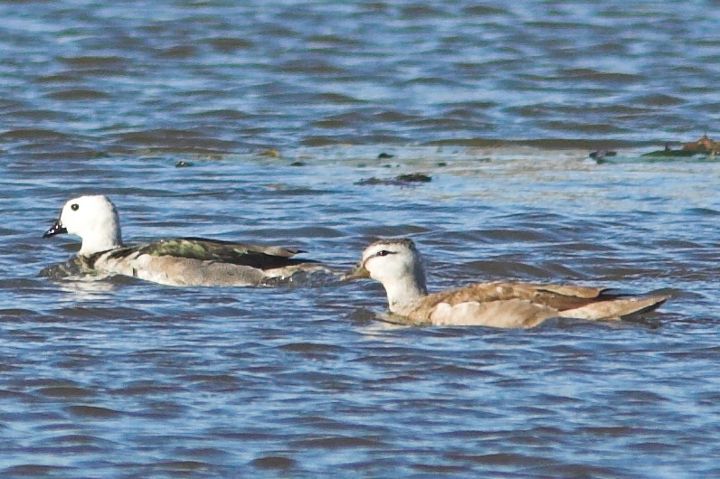
Among the smallest waterfowl in the world, small individuals only 160 g and 26 cm. The goose-like bill is short and deep at the base. The male has a dark brown forehead and crown, a broad blackish-green collar at the base of the neck, white head sides and neck, and dark brown back, coverts and scapulars with green and purple gloss; in flight the wings are dark with white flight feathers tipped black. The female has a duller cap, a brown line through the eye, spots in place of the collar and a flecked face. Red iris, black legs.
Habitat
Small to large waters with good aquatic vegetation: ponds, lakes, reservoirs and paddies, in pairs or groups of pairs, roosting in waterside trees and nesting in tree holes. A strong flier that disperses widely in winter.
Distribution
Breeds in South and South-East Asia and on to Queensland in Australia; found in southern China, Hainan and Taiwan and common on Singapore's wetlands and reservoirs; only a vagrant to Japan. Breeding follows the rains.
Season and behaviour
Seen all year in Singapore, breeding in the rainy season; most numerous in southern China from April to September. Usually among water lilies and floating leaves, where it is easily overlooked.
Photography tips
These are the FilmAnalysis editors' notes, not content from the sources.
It swims among lilies and floating leaves: a long lens from low down spreads the leaves as foreground, and the white head and neck clip easily, so half a stop under. The male's black-green collar colours only in front light. On take-off the white flight feathers with black tips flash at 1/2000 s. Do not disturb adults near a nest hole.
Field ethics: keep a distance at which the bird does not change its behaviour; never approach or publish nest sites; no baiting, playback or flash; never clear vegetation around a nest; follow reserve rules and stay on paths.
Photographic styles
A small duck in a lily pond; fresh white and green.
Similar species
Female teal (brown, much larger, no white face); no other duck is this small.
Related badge
The album badge "a duck" unlocks when the vision model explicitly names a a duck in your photo and you rate the analysis. The badge stops at "a duck": it does not tell species apart, and this page existing unlocks nothing.
The illustration is original FilmAnalysis artwork. The photograph is from Wikimedia Commons; its licence and author are under it.