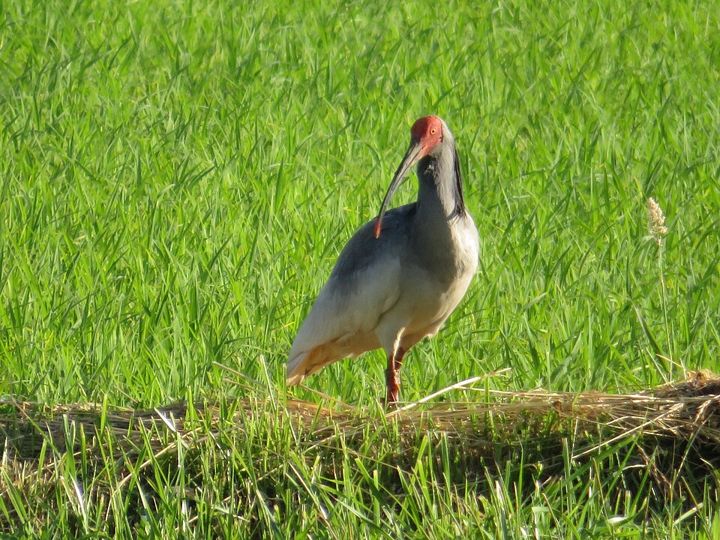
A medium-to-large ibis, 55–78.5 cm long, with a bare red face and a dense drooping crest of plumes on the nape. The plumage changes with season: in winter largely white with salmon-pink tones on the wings and tail; in summer pale grey above and on the breast with a darker grey shawl across the back, white tinged pink below. In flight the upper wings and tail are white and the undersides of the flight feathers strongly flushed pink. The long, strongly downcurved bill is black with a red tip; legs and feet red.
Habitat
Paddies, river beds and wetlands in temperate hills, feeding on loach, frogs and water insects in paddies and shallow streams, nesting and roosting in tall pines and oaks; dependent on pesticide-free farmland.
Distribution
Once widespread across eastern China, Korea and Japan; by the late twentieth century the wild population was down to seven birds at Yangxian, Shaanxi. Protection brought about a thousand wild birds by 2014 and more than seven thousand in all by 2021, with reintroductions in South Korea and on Sado Island, Japan. Called toki in Japanese, and its scientific name is simply Japan. Absent from Singapore.
Season and behaviour
Seen all year in the Hanzhong basin of Shaanxi, breeding from March to June in greyish summer plumage; in winter, white tinged pink, it feeds in flocks on harvested paddies. The released Sado population is present all year.
Photography tips
These are the FilmAnalysis editors' notes, not content from the sources.
The pink under the wings in flight is its most moving colour: backlight or side backlight against sky or a dark hill, at 1/1600 s. The pink-white winter plumage is truest in soft light and clips easily in direct sun. The Yangxian birds have lived beside farmers for years, but still use a long lens and never approach nest trees or roosts: a first-class protected species.
Field ethics: keep a distance at which the bird does not change its behaviour; never approach or publish nest sites; no baiting, playback or flash; never clear vegetation around a nest; follow reserve rules and stay on paths.
Photographic styles
Pink wings over paddies; the gentle tones of a Chinese mountain village.
Similar species
Eurasian spoonbill (flat bill, not downcurved); egrets (straight bill, black legs, no pink).
Related badge
None yet. No validated photo recognition exists for this species, so no badge is tied to it: a name in the encyclopedia is not evidence in a photograph.
The illustration is original FilmAnalysis artwork. The photograph is from Wikimedia Commons; its licence and author are under it.