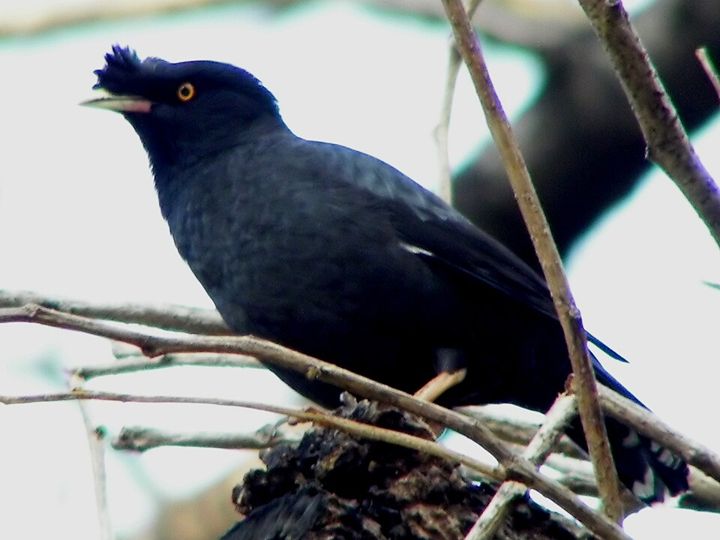
Mostly black with a slight green sheen and a tuft of feathers on the forehead forming a crest over the nostrils, which gives the Chinese name. White wing patches show in flight; the primaries are white at base and tip, the tail feathers white-tipped except the central pair, and the undertail coverts black with white tips. Adults have orange eyes, a slender sharp pale-yellow bill and dull dark-yellow legs. The female's crest is slightly smaller.
Habitat
Open ground near towns and farmland: parks, lawns, pasture, villages and refuse sites, walking in small groups and following cattle and mowers.
Distribution
Native to south-eastern China and Indochina and common in towns and countryside south of the Yangtze; carried about as a cage bird, with feral populations in Taiwan, the Philippines and the Malay Peninsula; introduced around 1890 to Vancouver and later lost there. Only odd escapes in Japan and Singapore.
Season and behaviour
Resident, seen all year. Breeds April to July in tree holes, eaves and holes in utility poles. A gifted mimic and a traditional Chinese cage bird; wild birds are just as loud and talkative.
Photography tips
These are the FilmAnalysis editors' notes, not content from the sources.
The black plumage and orange eye need side light: meter on the bird and pull back slightly to keep the crest's shape. The white wing flash on take-off is the most recognisable moment, so preset 1/2000 s. On lawns it is unafraid; crouch with a medium telephoto and the grass blurs into green.
Field ethics: keep a distance at which the bird does not change its behaviour; never approach or publish nest sites; no baiting, playback or flash; never clear vegetation around a nest; follow reserve rules and stay on paths.
Photographic styles
Black silhouettes on green grass; the everyday of city and field.
Similar species
Common myna (brown body, yellow bare skin round the eye, common in Singapore); Javan myna (grey-black, no crest, Singapore's commonest myna); silky starling (white head, grey body).
Related badge
None yet. No validated photo recognition exists for this species, so no badge is tied to it: a name in the encyclopedia is not evidence in a photograph.
The illustration is original FilmAnalysis artwork. The photograph is from Wikimedia Commons; its licence and author are under it.