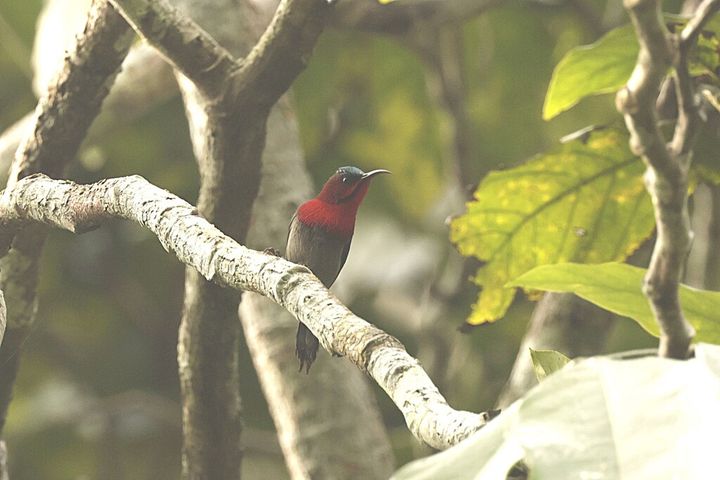
Photo: Russ Namitz, via iNaturalist, public domain / CC0. Unmodified apart from resizing.
Region
Singapore and tropical Asia
Habitat
towns and gardens, forest
Colour
red, yellow, green
Size
small (under about 20 cm)
Identification
Only about 11 cm, with a medium-length, thin, down-curved bill and a brush-tipped tubular tongue for nectar. The male has a crimson breast, maroon back, black malar stripes, yellow rump and olive belly, and in most of the range a long green-blue central tail. The female has an olive-green back, yellowish breast and white tips to the outer tail feathers.
Habitat
Forest and cultivated land; often at flowering shrubs in gardens.
Distribution
Resident across tropical southern Asia from India, Nepal, Pakistan, Bangladesh and Myanmar to Indonesia and Brunei; common in Singapore, where the Nature Society named it the unofficial national bird.
Season and behaviour
Mostly nectar, plus insects when feeding young. Fast, direct flight; it can hover like a hummingbird but usually perches to feed. The call is 'chee-cheewee'. The nest hangs in a tree and holds two or three eggs.
Photography tips
These are the FilmAnalysis editors' notes, not content from the sources.
Wait by a flowering shrub: it returns to the same flowers again and again. The male's red is so saturated that midday top light flattens it; side light early or late, or overcast light, keeps the feather detail. Hovering needs 1/3200 s or faster, or go the other way with about 1/60 s for wing blur. The flowers are its food: never break stems for a cleaner frame.
Field ethics: keep a distance at which the bird does not change its behaviour; never approach or publish nest sites; no baiting, playback or flash; never clear vegetation around a nest; follow reserve rules and stay on paths.
Photographic styles
Saturated bird-and-flower pictures; moments between bird and blossom.
Similar species
Ornate sunbird (yellow underparts, male with a purple-black throat); females of other sunbirds are similar, so check the white tail tips.
Related badge
None yet. No validated photo recognition exists for this species, so no badge is tied to it: a name in the encyclopedia is not evidence in a photograph.
The illustration is original FilmAnalysis artwork. The photograph is from iNaturalist; its licence and author are under it.
Why it is listed: this bird is named in the YouTube video description (波遊足跡 EP1) (the description text, not the subtitles). The video only shows that it was mentioned; names follow the IOC World Bird List 15.2 and the facts follow the sources below.