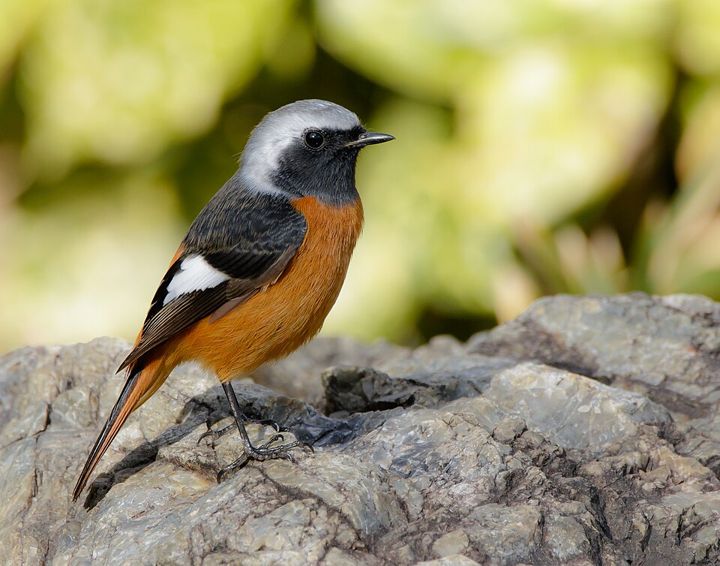
14–15 cm, 11–20 g, strongly sexually dimorphic. The breeding male has a grey crown and nape, black face and chin, brownish mantle and wings with a large white wing patch, orange breast, lower back and rump, and a black tail with orange sides; the female is warm brown above, paler below, with an orange rump and tail sides and the same large white wing patch. Bill, eye and legs black in both sexes.
Habitat
Forest edge, scrub, parks, gardens, farmland and village surroundings, perching on low exposed branches, fences and stones and shivering its tail constantly.
Distribution
Breeds in temperate Central and East Asia and winters in southern China and north-east India. A common winter visitor to eastern China and Japan, where its autumn arrival as jōbitaki is keenly awaited.
Season and behaviour
In eastern China and Japan commonest from October to March, each bird holding a winter territory; males give a ticking call to proclaim it. Northward migration from April.
Photography tips
These are the FilmAnalysis editors' notes, not content from the sources.
In winter each bird has a fixed territory and a few favourite perches: find them and return at the same hour each day. The orange underparts glow in side backlight against dark scrub. It pauses briefly after each tail-shiver, so fire bursts then; the white wing patch is the field mark both sexes share, so do not crop it out.
Field ethics: keep a distance at which the bird does not change its behaviour; never approach or publish nest sites; no baiting, playback or flash; never clear vegetation around a nest; follow reserve rules and stay on paths.
Photographic styles
Warm winter portraits of a small bird; garden quiet.
Similar species
Black redstart (male blacker, smaller wing patch); plumbeous water redstart (male slate-blue with a chestnut tail, on streams); females of other redstarts lack the white wing patch.
Related badge
None yet. No validated photo recognition exists for this species, so no badge is tied to it: a name in the encyclopedia is not evidence in a photograph.
The illustration is original FilmAnalysis artwork. The photograph is from Wikimedia Commons; its licence and author are under it.