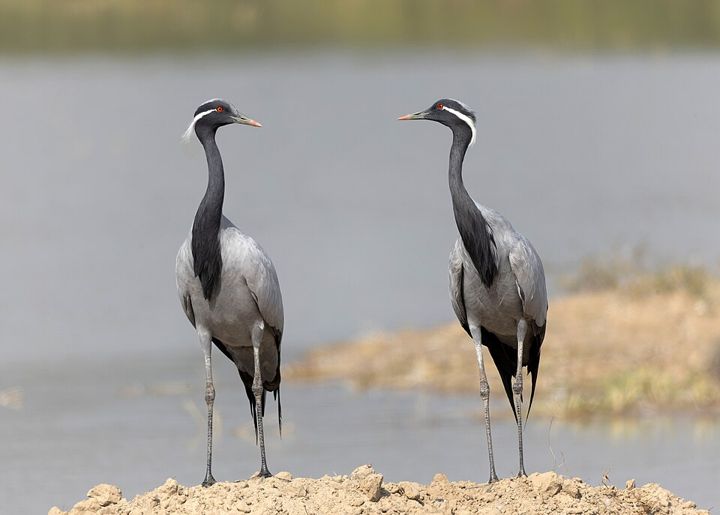
The smallest crane, 85–100 cm long, 76 cm tall, wingspan 155–180 cm, 2–3 kg. Plumage like a common crane's but smaller and paler: black head and neck, a long white plume of ear feathers trailing down the neck side behind the eye, and the black of the foreneck extending as a plume over the chest; blue-grey body with drooping grey tertials. A trumpeting call higher-pitched than the common crane's, and a dancing display more balletic, with less leaping.
Habitat
Open country with sparse vegetation, steppe, semi-desert and farmland, usually near water, nesting on the ground; winters on fields and river beds.
Distribution
Breeds in central Eurasia from the Black Sea to Mongolia and north-east China, with a small population in Turkey; western birds winter in the African Sahel and Asian birds on the Indian subcontinent, crossing the Himalayas on migration. Breeds on the steppes of Inner Mongolia, Xinjiang and the north-east from April to September; a rare vagrant to Japan; absent from Singapore. Symbolic in Indian culture.
Season and behaviour
On the Inner Mongolian steppe from April to September, pairs dancing in May and June; flocks leave south in September. Occasional passage birds stop in Tibet and Yunnan.
Photography tips
These are the FilmAnalysis editors' notes, not content from the sources.
On the steppe they are wary: photograph the pair dance from far off with a car as a hide, 1/1600 s; the white ear plumes and black chest plume want a front-lit profile. In early morning steppe mist the blue-grey body against yellow-green grass is a gentle palette. Never flush them for flight and never approach a nest.
Field ethics: keep a distance at which the bird does not change its behaviour; never approach or publish nest sites; no baiting, playback or flash; never clear vegetation around a nest; follow reserve rules and stay on paths.
Photographic styles
A pair of cranes in steppe mist; soft blue-grey and pale green.
Similar species
Common crane (larger, red crown patch, no long ear plumes or chest plume); white-naped crane (white neck sides, red face).
Related badge
The album badge "a crane" unlocks when the vision model explicitly names a a crane in your photo and you rate the analysis. The badge stops at "a crane": it does not tell species apart, and this page existing unlocks nothing.
The illustration is original FilmAnalysis artwork. The photograph is from Wikimedia Commons; its licence and author are under it.