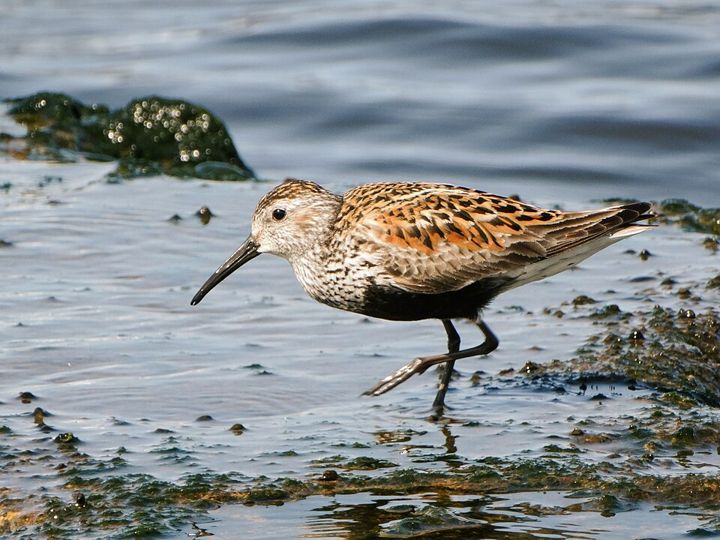
Photo: Jevgenijs Slihto from Riga, Latvia, via Wikimedia Commons, licensed CC BY 2.0. Unmodified apart from resizing.
Region
Japan and temperate East Asia
Habitat
coast and mangroves
Colour
brown, white, black
Size
small (under about 20 cm)
IUCN status
Near Threatened
IOC breeding range
NA, PAL (low (locally high) Arctic to temperate wet tundra of Holarctic: sw to ne Greenland, Iceland, Faroe Is., n British Isles, Scandinavia, Baltic states e through n Russia including Novaya Zemlya (n of nw Siberia) and New Siberian Is. (n of ec Russia), through Chukotskiy Pen., w Kamchatka, n Kurile and n Sakhalin is. (e Russia); Aleutian Is., w, n Alaska, nw Canada, nc Canada n and w of Hudson Bay)
IOC non-breeding range
s NA, AF, s PAL : coastal and inland wetlands from temperate to tropical zones n of Equator: British Isles, w Europe, Mediterranean, n, nc Africa, Middle East, n Indian subcontinent to n Vietnam and e China, Taiwan, Korean Pen. and Japan (except n); sw Canada and New England to wc Mexico and Yucatan Pen.
Identification
16–20 cm long, wingspan 38–43 cm. In breeding plumage a large black belly patch that no similar-sized wader has; in winter greyish brown above and white below. Juveniles are brown above with two faint white Vs on the back and black marks on the flanks and belly. All ages show a narrow white wing-bar in flight. Legs and slightly decurved bill black.
Habitat
Breeds on wet Arctic and subarctic tundra; at other times on estuary mud, beaches, salt pans and inland wetlands, one of the most numerous small waders on East Asian coasts in winter, in dense flocks of thousands.
Distribution
Circumpolar breeder in North America, Europe and northern Asia; western European birds are short-distance migrants, those from far northern Eurasia travel to temperate and northern tropical coasts. Large wintering numbers on the coasts of eastern China and Japan's estuaries from September to May; rare in Singapore.
Season and behaviour
Most numerous in eastern China and Japan from October to April; the black-bellied breeding plumage appears in April–May before departure, the best time to photograph it. Flocks wheel in unison, flashing their white bellies.
Photography tips
These are the FilmAnalysis editors' notes, not content from the sources.
The flock's synchronised flash needs 1/2000 s and a slightly wider lens, most dramatic against the light. In spring, go low with a long lens for a single black-bellied bird. At high tide the roosting flock is closest to shore; never flush them, their winter energy is precious.
Field ethics: keep a distance at which the bird does not change its behaviour; never approach or publish nest sites; no baiting, playback or flash; never clear vegetation around a nest; follow reserve rules and stay on paths.
Photographic styles
Patterns of wheeling flocks; the grey tones of the flats.
Similar species
Curlew sandpiper (longer, more curved bill, white rump, brick-red breeding plumage); red-necked stint (smaller, short straight bill); sanderling (whiter in winter, no hind toe).
Related badge
None yet. No validated photo recognition exists for this species, so no badge is tied to it: a name in the encyclopedia is not evidence in a photograph.
The illustration is original FilmAnalysis artwork. The photograph is from Wikimedia Commons; its licence and author are under it.