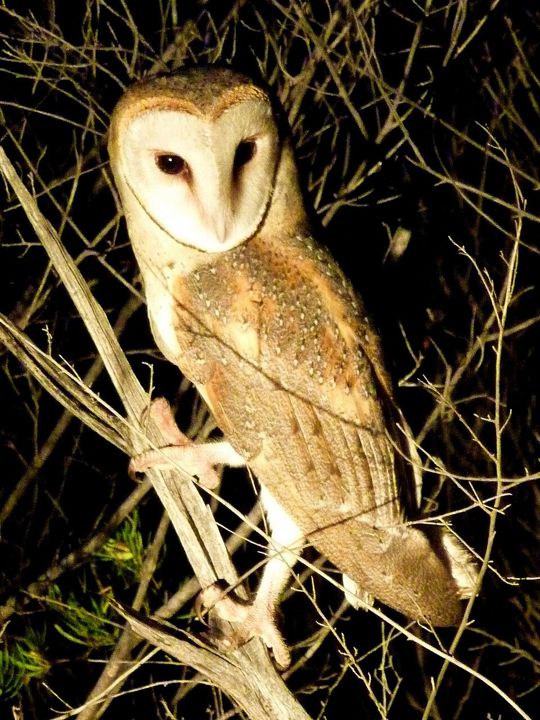
Photo: Christopher Watson (http://www.comebirdwatching.blogspot.com/), via Wikimedia Commons, licensed CC BY-SA 3.0. Unmodified apart from resizing.
Region
Singapore and tropical Asia
Habitat
towns and gardens
Colour
white, orange, brown
Size
medium (20 to 50 cm)
IOC breeding range
OR, AU, PO (s, se Asia to Australasia and sw Pacific)
Identification
A medium-sized owl with a heart-shaped white facial disc, black eyes and no ear tufts; golden-brown upperparts washed grey with fine black-and-white speckles, white to buff underparts with sparse small spots, long legs. Usually treated as the eastern subspecies group of the cosmopolitan barn owl, but split as a species by the International Ornithologists' Union and others. Its hearing is acute enough to locate prey by sound alone.
Habitat
Open country, farmland, coconut groves, city edges and derelict buildings, nesting in tree holes, building lofts and nest boxes; nocturnal, feeding mainly on rodents, and present in Singapore's industrial estates and port areas.
Distribution
Native to the Indian subcontinent, South-East Asia, Australasia and many Pacific islands; a small steady population in Singapore and a few records from southern China and Taiwan; first recorded breeding in New Zealand in 2008. Absent from Japan. Generally sedentary.
Season and behaviour
Seen all year in Singapore, leaving the roost after dusk with a rasping screech; by day it rests in building crevices and dense palms.
Photography tips
These are the FilmAnalysis editors' notes, not content from the sources.
Once you find the day roost, photograph the white face from far off with a long lens; never shine a light on it and never use flash, since the black eyes in the white disc need only a little ambient light. For the dusk flight use high ISO and 1/500 s beside its regular exit. Keep quiet near nest boxes and building nests.
Field ethics: keep a distance at which the bird does not change its behaviour; never approach or publish nest sites; no baiting, playback or flash; never clear vegetation around a nest; follow reserve rules and stay on paths.
Photographic styles
Portraits of a heart-shaped white face; silent flight at dusk.
Similar species
Eastern grass owl (darker disc and body, in grassland, southern China); no other owl has a heart-shaped white face.
Related badge
The album badge "an owl" unlocks when the vision model explicitly names a an owl in your photo and you rate the analysis. The badge stops at "an owl": it does not tell species apart, and this page existing unlocks nothing.
The illustration is original FilmAnalysis artwork. The photograph is from Wikimedia Commons; its licence and author are under it.