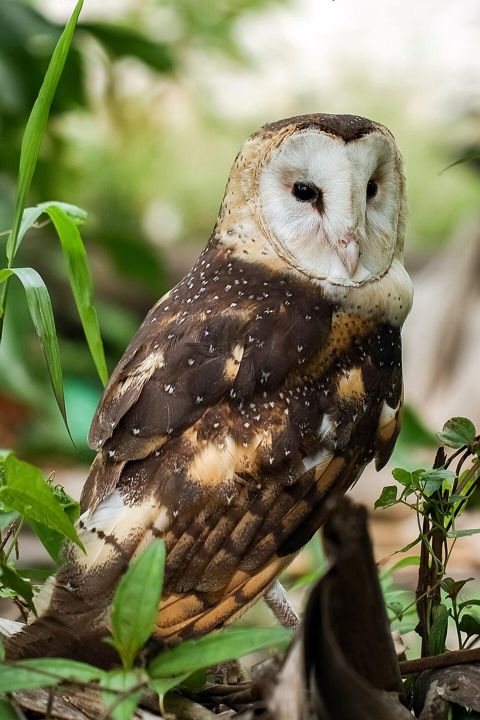
Photo: Ronny Overhate, via Wikimedia Commons, public domain / CC0. Unmodified apart from resizing.
Region
Japan and temperate East Asia, Singapore and tropical Asia
Habitat
towns and gardens
Colour
brown, white
Size
medium (20 to 50 cm)
IUCN status
Least Concern
IOC breeding range
OR, AU (e India to e China, Philippines, Taiwan, Sulawesi, se New Guinea, n, ne Australia and New Caledonia)
Identification
A medium-sized owl about the size of a barn owl: males 32–38 cm, the larger females 35–42 cm, wingspan 100–116 cm. Dark brown or tan upperparts with pale spots, black and tan bars on the wings, a very pale bill, feathered legs and dark brown eyes; like all Tyto owls a heart-shaped facial disc, brown-buff with a white border. Darker overall and longer-legged than the barn owl.
Habitat
Tall grassland and swamps, making systems of tunnels through the grass and roosting and nesting on flattened vegetation; hunts rodents in low flight over the grass at night.
Distribution
Eastern India to eastern China, the Philippines, Taiwan, Sulawesi, south-east New Guinea, northern and north-eastern Australia and New Caledonia; in the grasslands of southern and eastern China and Taiwan; a vagrant to Japan; absent from Singapore. Some consider it conspecific with the African grass owl.
Season and behaviour
Resident, seen all year; the silent low hunting flight over tall grass after dusk is the one easy time to see it. In winter one is occasionally flushed from dead grass.
Photography tips
These are the FilmAnalysis editors' notes, not content from the sources.
At dusk it quarters the grassland low: high ISO, 1/640 s and continuous focus beside its regular beat. Never walk into the tall grass to find its tunnels, which would destroy its shelter. The white face is the brightest thing in the twilight, so half a stop under.
Field ethics: keep a distance at which the bird does not change its behaviour; never approach or publish nest sites; no baiting, playback or flash; never clear vegetation around a nest; follow reserve rules and stay on paths.
Photographic styles
Low flight over dusk grassland; the instant of a heart-shaped white face.
Similar species
Barn owl (paler, shorter legs, around buildings and trees); short-eared owl (yellow eyes, short tufts, the same grasslands).
Related badge
The album badge "an owl" unlocks when the vision model explicitly names a an owl in your photo and you rate the analysis. The badge stops at "an owl": it does not tell species apart, and this page existing unlocks nothing.
The illustration is original FilmAnalysis artwork. The photograph is from Wikimedia Commons; its licence and author are under it.