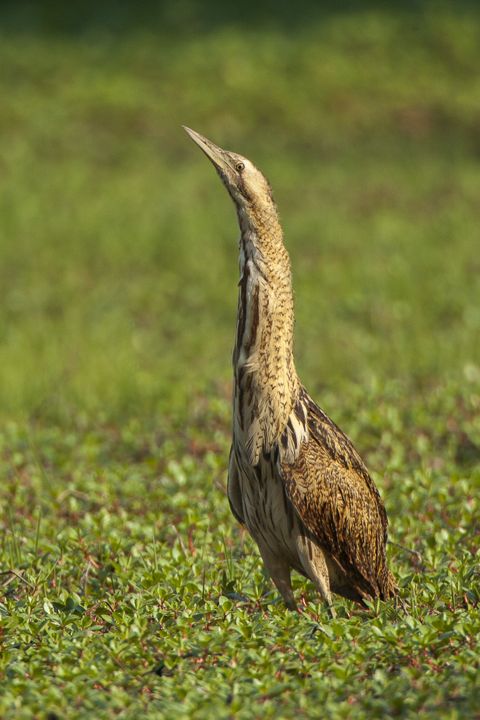
A thickset heron, the largest bittern, 69–81 cm long with a wingspan of 100–130 cm and weighing 0.87–1.94 kg, males larger than females. Bright pale buffy-brown plumage covered with dark streaks and bars; crown and nape black, head and neck sides tawny-buff barred black, a yellowish-buff brow and a brownish-black moustache. Alarmed, it points its bill skyward and melts into the reeds.
Habitat
Extensive reed beds and dense waterside vegetation, seldom in the open; in spring the male's booming call, like someone blowing across a bottle far away, carries for kilometres.
Distribution
Two subspecies: the northern race breeds in Europe and across the Palearctic including the North African coast, the southern race is endemic to southern Africa. Breeds in north-east and north-west China and winters in the Yangtze basin and southern China; a scarce winter visitor and local breeder in Japan; absent from Singapore.
Season and behaviour
In eastern China from October to March, easiest to see standing at the water's edge when the reeds are winter-yellow; breeds in the north from April to June. Mostly active at dawn and dusk, flying on broad wings with the neck drawn in and legs trailing.
Photography tips
These are the FilmAnalysis editors' notes, not content from the sources.
When a reed pond freezes and only a little water stays open, it is forced into view: the best chance all year, with a long lens from a distance. Its colours match dead reeds exactly, so only a clean background reveals it; a wide aperture blurs the reeds in front and behind. The sky-pointing pose is the classic, and 1/500 s is enough.
Field ethics: keep a distance at which the bird does not change its behaviour; never approach or publish nest sites; no baiting, playback or flash; never clear vegetation around a nest; follow reserve rules and stay on paths.
Photographic styles
Camouflage in the colour of dead reeds; the tawny tones of a winter marsh.
Similar species
Black and yellow bitterns (much smaller); juvenile night heron (brown with white spots, stockier, orange eye).
Related badge
None yet. No validated photo recognition exists for this species, so no badge is tied to it: a name in the encyclopedia is not evidence in a photograph.
The illustration is original FilmAnalysis artwork. The photograph is from Wikimedia Commons; its licence and author are under it.