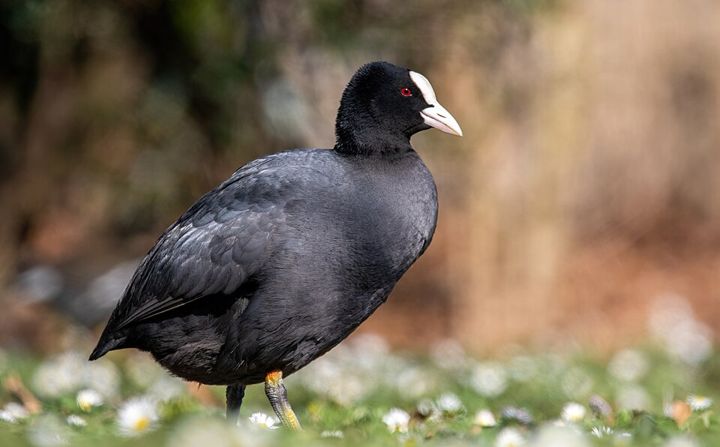
36–38 cm long, wingspan 70–80 cm. Slaty black with a glossy head, white bill and frontal shield and red eyes; the long strong toes are lobed for swimming and diving. The sexes are alike. Juveniles are paler with a whitish breast and no shield, which is fully developed only at about a year. Noisy, with crackling, explosive and trumpeting calls, often at night.
Habitat
Freshwater lakes, ponds, reservoirs and slow rivers, preferring open water to dense vegetation; dives for water plants and also grazes on banks.
Distribution
Breeds across much of the Old World in Europe, Asia, Australia, New Zealand and parts of North Africa; northern birds winter south to North Africa, South-East Asia and the Philippines. Winter flocks on large waters in China and Japan; almost unrecorded in Singapore.
Season and behaviour
Most numerous in eastern China and Japan from October to April; breeds in northern Japan and northern China. In winter hundreds or thousands gather on lakes, and take-off needs a long run across the water.
Photography tips
These are the FilmAnalysis editors' notes, not content from the sources.
The white bill and shield on a black body are a ready-made focal point, best on dark water in side or back light; keep detail in the black. On take-off it patters across the surface: 1/2000 s for the trail of splashes. Winter fights, wings raised and feet kicking water, happen on park ponds.
Field ethics: keep a distance at which the bird does not change its behaviour; never approach or publish nest sites; no baiting, playback or flash; never clear vegetation around a nest; follow reserve rules and stay on paths.
Photographic styles
Black-and-white patterns on water; winter crowds.
Similar species
Common moorhen (red shield and bill, white flank line); juveniles are told from other young rails by size and lobed toes.
Related badge
None yet. No validated photo recognition exists for this species, so no badge is tied to it: a name in the encyclopedia is not evidence in a photograph.
The illustration is original FilmAnalysis artwork. The photograph is from Wikimedia Commons; its licence and author are under it.