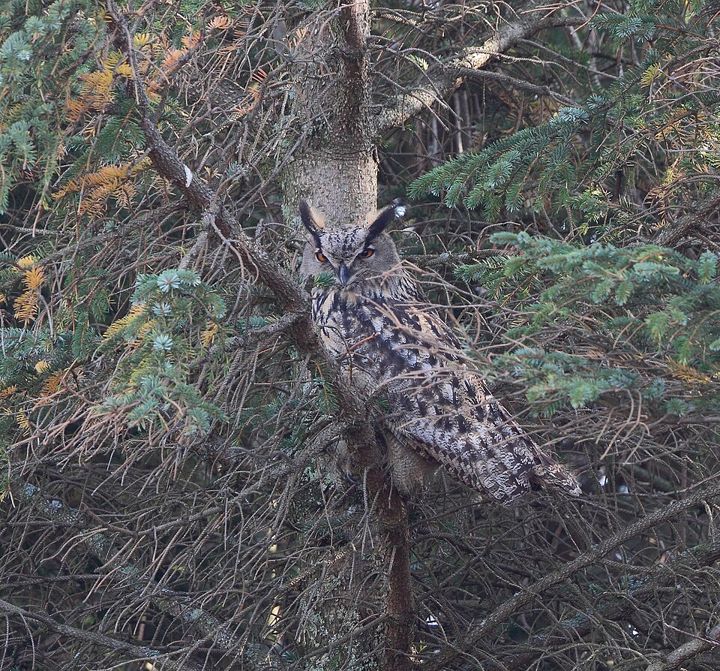
One of the largest owls: females reach 75 cm in length with a wingspan of 188 cm, males slightly smaller. Long prominent ear tufts; tawny upperparts mottled with blackish, barred wings and tail, tawny underparts with dark streaks heaviest on the breast. Orange eyes and a rather indistinct facial disc. Weights reach 4.6 kg, matching Blakiston's fish owl.
Habitat
Wooded mountains, bare rock and cliffs, also quarries and river gorges, nesting on ledges; hunts at night for anything from rodents to hares, hedgehogs and other birds, including other raptors.
Distribution
Across Eurasia: Scandinavia and Russia east to Sakhalin and the Kurils, south to Iran, India and Myanmar, most of China, and from the southern edge of the Sahara to Arabia; breeds on cliffs in northern China and in the North China hills; only a handful of records from Hokkaido in Japan; absent from Singapore.
Season and behaviour
Resident, seen all year. The deep oo-hu courtship call on January to March nights is the best way to locate it; by day it rests in a cliff hollow or a pine.
Photography tips
These are the FilmAnalysis editors' notes, not content from the sources.
At dusk, when it stands on a cliff top or ledge, take the silhouette with a long lens on a tripod at about 1/250 s with stabilisation. The orange eyes are complete only when it looks at the lens; never go close enough for that look to make it fly. Keep well away from cliff nests: a protected species that will desert if disturbed while breeding.
Field ethics: keep a distance at which the bird does not change its behaviour; never approach or publish nest sites; no baiting, playback or flash; never clear vegetation around a nest; follow reserve rules and stay on paths.
Photographic styles
Cliff and dusk silhouettes; the still portrait of a great bird.
Similar species
Long-eared owl (much smaller and slimmer); Blakiston's fish owl (heavier, ragged tufts, by streams in the north-east and Hokkaido); great grey owl (no tufts, huge facial disc, yellow eyes).
Related badge
The album badge "an owl" unlocks when the vision model explicitly names a an owl in your photo and you rate the analysis. The badge stops at "an owl": it does not tell species apart, and this page existing unlocks nothing.
The illustration is original FilmAnalysis artwork. The photograph is from Wikimedia Commons; its licence and author are under it.