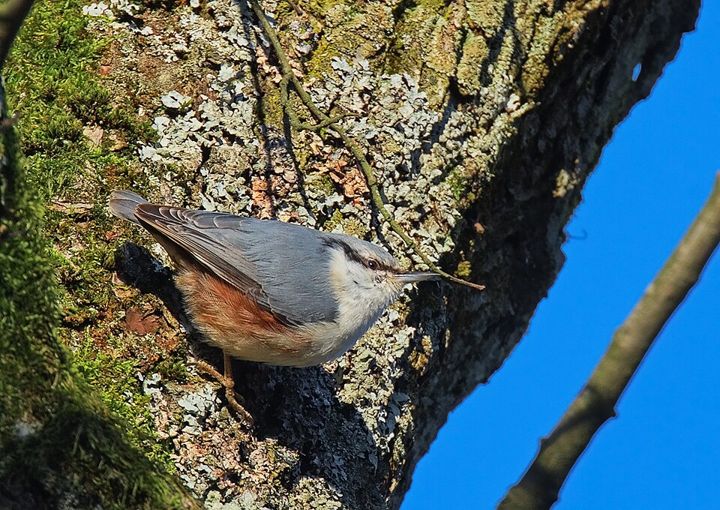
About 14 cm long, wingspan 22.5–27 cm, 17–28 g. Short tail, long straight bill angled slightly upward. Blue-grey above with a black eye-stripe, white or buff throat and underparts, orange-red flanks and lower belly, white spots under the tail; East Asian subspecies are paler below. It moves on trunks in short hops and comes down head first without using the tail for support. A loud repeated dwip.
Habitat
Mature deciduous and mixed woodland, parks and gardens with old trees, searching bark crevices for insects, wedging nuts into bark to hammer them open in autumn and caching food; nests in tree holes and narrows the entrance with mud.
Distribution
Throughout the Palearctic, the commonest and most widespread nuthatch, with more than twenty subspecies in three groups: orange-buff below in the west, white in Russia, similar but paler in the east. Common in the hills of north-east and northern China and throughout Japan; absent from Singapore.
Season and behaviour
Resident, seen all year. In winter it joins tit flocks and is bold at feeders; calls most from February to April and raises young from April to June.
Photography tips
These are the FilmAnalysis editors' notes, not content from the sources.
Walking head-first down a trunk is its signature picture: fire at the moment it pauses and lifts its head, 1/800 s. The blue-grey back needs soft side light or it goes dull; a wide aperture darkens the bark pattern. Winter feeders and the mud-rimmed nest hole are fixed spots.
Field ethics: keep a distance at which the bird does not change its behaviour; never approach or publish nest sites; no baiting, playback or flash; never clear vegetation around a nest; follow reserve rules and stay on paths.
Photographic styles
Vertical studies on a trunk; blue-grey and orange in the Japanese palette.
Similar species
Chestnut-vented nuthatch (deep chestnut flanks, central and southern China); Chinese nuthatch (black crown, northern China); white-cheeked nuthatch (all-white face, south-western mountains).
Related badge
None yet. No validated photo recognition exists for this species, so no badge is tied to it: a name in the encyclopedia is not evidence in a photograph.
The illustration is original FilmAnalysis artwork. The photograph is from Wikimedia Commons; its licence and author are under it.