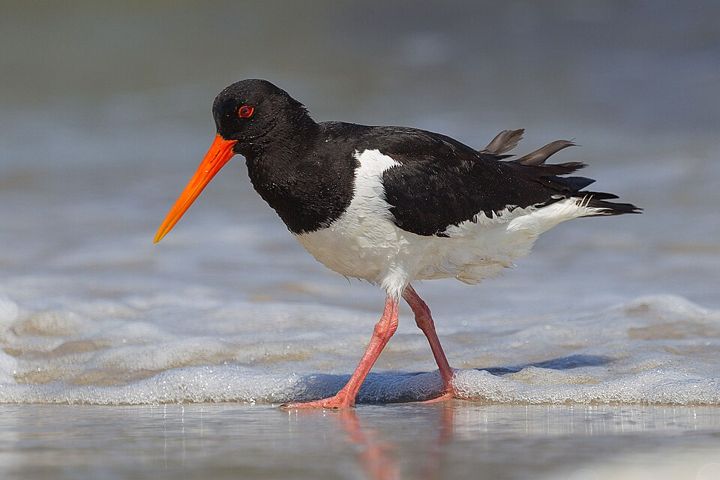
One of the largest waders of the region, 40–45 cm long with the bill accounting for 8–9 cm and a wingspan of 80–85 cm. Boldly pied: black head, breast and upperparts, white below; a long, straight, strong orange-red bill used to smash or prise open mussels and other molluscs and to find earthworms; red eye, rather short dull-pink legs. The female's bill is longer than the male's. In winter a white throat collar. A white wing-bar shows in flight.
Habitat
Coastal mud, sand, rocky shores, estuaries and salt pans, noisy and conspicuous; lays in a scrape on shingle or sand.
Distribution
The most widespread oystercatcher, with three or four subspecies breeding in western Europe, the central Palearctic, Kamchatka and the west coasts of China and Korea, with no other oystercatcher in its range. China's breeders are on the Liaoning and Shandong coasts, wintering in Jiangsu, Fujian and elsewhere; small winter flocks in Japan, such as Tokyo Bay; absent from Singapore.
Season and behaviour
Breeds on China's Bohai coast from April to July and winters on the south-east coast from October to March; in Japan from October to April. Roosts in flocks on sandbars at high tide with a loud shrill kleep.
Photography tips
These are the FilmAnalysis editors' notes, not content from the sources.
The orange-red bill and eye on a pied body are a natural focus, most saturated in front light; side backlight for the shell-prising action. When the tide pushes the flock onto a sandbar, go low with a long lens for the clean black, white and orange in the reflection. Keep away from breeding shingle.
Field ethics: keep a distance at which the bird does not change its behaviour; never approach or publish nest sites; no baiting, playback or flash; never clear vegetation around a nest; follow reserve rules and stay on paths.
Photographic styles
High contrast of black, white and orange; tideline minimalism.
Similar species
No similar species; from afar like a big pied plover, but the long orange-red bill is unique.
Related badge
None yet. No validated photo recognition exists for this species, so no badge is tied to it: a name in the encyclopedia is not evidence in a photograph.
The illustration is original FilmAnalysis artwork. The photograph is from Wikimedia Commons; its licence and author are under it.