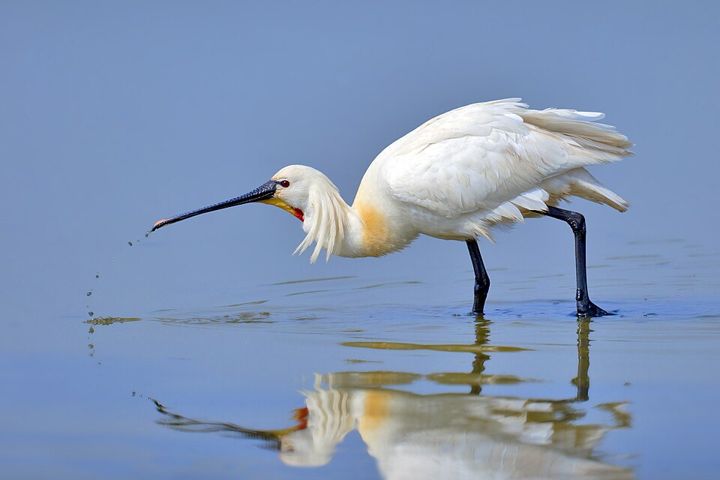
Almost unmistakable across its range: in breeding plumage all white with dark legs, a black bill with a yellow tip, a yellow breast patch like a pelican's and a crest on the nape. Non-breeders lack the crest and breast patch; immatures have a pale bill and black tips to the primaries. Unlike herons it flies with the neck outstretched. Mostly silent, with bill-snapping and occasional grunts at the colony.
Habitat
Shallow lakes, marshes, estuaries, fish ponds and salt pans, sweeping the bill through the water; nests colonially in reed beds or trees.
Distribution
Widespread in Europe, Asia and Africa, the northern breeders mostly moving south for winter. Breeds in northern China and winters on the middle and lower Yangtze and the south-east coast, common in winter at Poyang Lake and coastal wetlands; a scarce winter visitor to Japan, often with black-faced spoonbills; absent from Singapore.
Season and behaviour
Winters in eastern China from October to April and breeds on northern wetlands from May to July; small numbers in Japan from November to March. Rests in groups by day with the bill tucked into the back.
Photography tips
These are the FilmAnalysis editors' notes, not content from the sources.
The yellow bill tip and breast patch separate it from the black-faced spoonbill and are the accent of the picture; against the light the sweeping bill throws spray at 1/2000 s. Half a stop under for the white plumage. Lines of birds flying with necks outstretched look best compressed against an evening sky.
Field ethics: keep a distance at which the bird does not change its behaviour; never approach or publish nest sites; no baiting, playback or flash; never clear vegetation around a nest; follow reserve rules and stay on paths.
Photographic styles
White flocks on wetlands; flight lines at dusk.
Similar species
Black-faced spoonbill (all-black bill and face, slightly smaller, East Asian coasts); egrets fly with the neck drawn in and have pointed bills.
Related badge
None yet. No validated photo recognition exists for this species, so no badge is tied to it: a name in the encyclopedia is not evidence in a photograph.
The illustration is original FilmAnalysis artwork. The photograph is from Wikimedia Commons; its licence and author are under it.