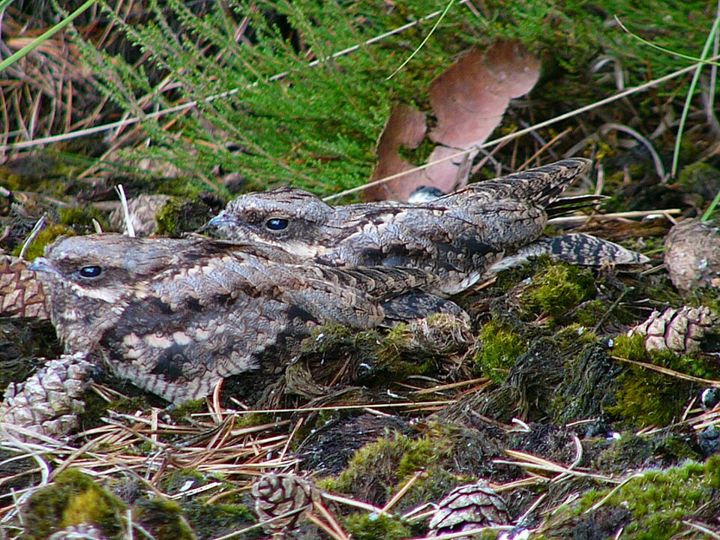
24.5–28 cm long, wingspan 52–59 cm, males 51–101 g, females 67–95 g. Greyish-brown upperparts with dark streaking, a pale buff hindneck collar and a white moustachial line; the closed wing grey with buff spotting, the underparts greyish-brown with brown barring and buff spots. Blackish bill, dark brown iris, brown legs and feet. Soft plumage makes the flight on long pointed wings silent and very buoyant. In flight the male shows a white patch across three primaries and white tips to the two outer tail feathers; females show no white.
Habitat
Open woodland, forest edge, heath and clearings, resting by day on the ground or along a branch; hawks moths and beetles at dusk. The Vaurie's nightjar, described from a single 1929 Xinjiang specimen, is now generally treated as a synonym of this species.
Distribution
Breeds across most of Europe and the Palearctic to Mongolia and north-western China; six subspecies grow smaller and paler eastward; all migrate to winter in Africa. A summer visitor to Xinjiang and western Inner Mongolia; absent from Japan and Singapore. The generic name recalls the old myth that nightjars suckled goats.
Season and behaviour
In Xinjiang from May to August, the male churring for minutes on end after dusk; very hard to find by day.
Photography tips
These are the FilmAnalysis editors' notes, not content from the sources.
Finding one by day is luck and the glint of an eye; then a long lens from far off, no approach and no light. For dusk flight use high ISO and 1/800 s tracking against the bright sky for a silhouette, the male's white wing spots the mark. Its camouflage on gravel, shot as a close-up, is the subject in itself.
Field ethics: keep a distance at which the bird does not change its behaviour; never approach or publish nest sites; no baiting, playback or flash; never clear vegetation around a nest; follow reserve rules and stay on paths.
Photographic styles
Camouflage and ground texture; silhouettes against the dusk sky.
Similar species
Grey nightjar (eastern, black central crown stripe, greyer); Egyptian nightjar (paler, sandy, western Central Asia).
Related badge
None yet. No validated photo recognition exists for this species, so no badge is tied to it: a name in the encyclopedia is not evidence in a photograph.
The illustration is original FilmAnalysis artwork. The photograph is from Wikimedia Commons; its licence and author are under it.