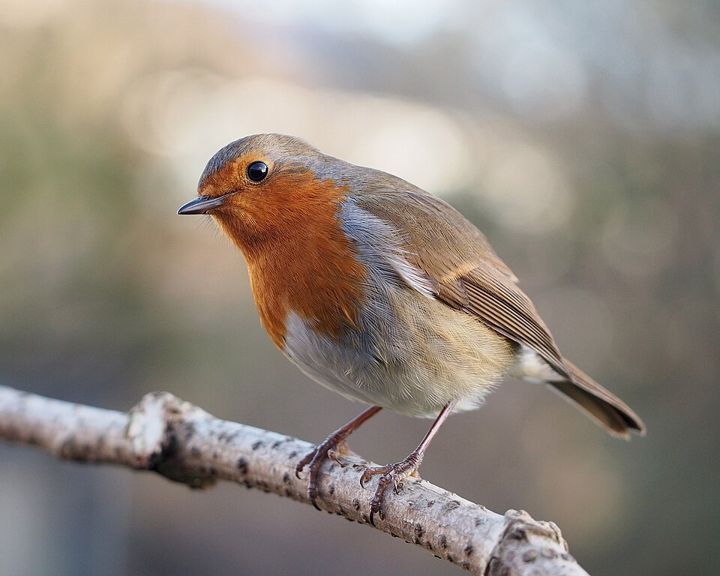
A small insectivorous songbird, 12.5–14 cm long, 16–22 g, wingspan 20–22 cm. Sexes alike: an orange breast and face lined with bluish grey on the sides of the neck and chest, brownish upperparts, whitish belly, brown legs and feet, black bill and eyes. Juveniles are spotted brown and white, the orange appearing gradually. Pugnacious; the red breast is a territorial signal.
Habitat
Woodland, scrub, parks and gardens; in Europe the tamest garden bird, following gardeners for turned-up worms, and nesting in holes, wall gaps and even flower pots.
Distribution
Throughout Europe, east to western Siberia and south to North Africa, and on the Azores and Madeira; sedentary in the west and south, migratory in the north and east. In China only a few records from north-west Xinjiang (an extreme vagrant in the east); a vagrant to Japan; absent from Singapore.
Season and behaviour
Seen all year in Europe, singing even in winter, the bird of Christmas cards; occasional in winter in the Altai and Ili regions of Xinjiang. A vagrant in the east draws a crowd of birders.
Photography tips
These are the FilmAnalysis editors' notes, not content from the sources.
It is fearless and will perch a metre away on a spade handle, so 35–135 mm is enough; the orange breast is truest in soft overcast light, and snow is the classic background at plus one stop. At dawn it sings from a low twig, the moment for the open bill. When a vagrant appears, take turns, keep quiet and do not feed it.
Field ethics: keep a distance at which the bird does not change its behaviour; never approach or publish nest sites; no baiting, playback or flash; never clear vegetation around a nest; follow reserve rules and stay on paths.
Photographic styles
One point of orange in snow; the everyday English garden.
Similar species
Japanese robin (male with a deeper orange head and neck, olive-brown back, Japan and eastern China); Siberian rubythroat (only the throat red, none in the female); female Daurian redstart (orange tail, white wing patch).
Related badge
None yet. No validated photo recognition exists for this species, so no badge is tied to it: a name in the encyclopedia is not evidence in a photograph.
The illustration is original FilmAnalysis artwork. The photograph is from Wikimedia Commons; its licence and author are under it.